On October 9, executive producer Holly Longdale and associate production director Clay Stone presented the PAX 2026 World of Warcraft: Forever panel keynote presentation.
I transcribed the portion where they deep-dive into the early development of World of Warcraft: Forever. At any time, if you wish to view an image in its full size, use your cursor and hold the right-button and select “Open image in New Tab.”
As always, if you appreciate my work with past Blizzard event transcripts, like BlizzCon, GamesCom, and PAX you may donate at paypal.me/blizzplanet — I’m currently unemployed and have lived with a few disabilities for over 20 years.
PAX 2026 World of Warcraft: Forever Panel Transcript
Clay Stone: What is World of Warcraft? We were coming into this, though, and we realized, you know, people flying to PAX from all around the world, and even though most folks we hope know what World of Warcraft is, we figured that might as well be a good spot to start. What the heck is World of Warcraft?
So World of Warcraft, for those who might not be familiar here, is a massively multiplayer online role-playing game. We launched this game back in 2004. It took the world by storm. Players create characters; they party together, they go on quests, they achieve and overcome incredible challenges such as fighting a large dragon.
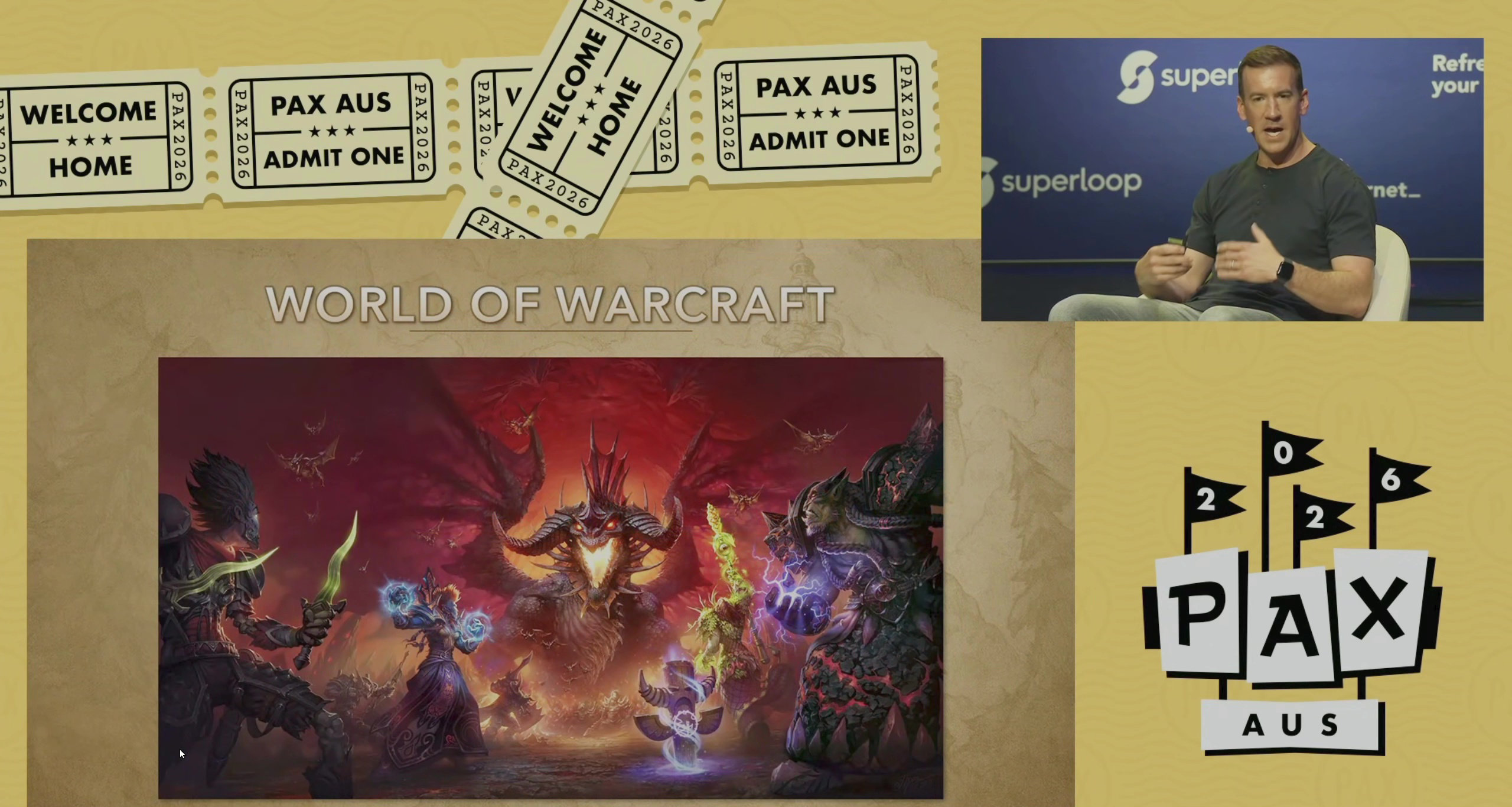
And they’ve been doing this for a long time. That is the game side of World of Warcraft. But when I think about World of Warcraft, it’s more than just a game; it is also a world, the world of Azeroth, and its is this world that exists almost 24/7, except for when we have downtime to patch, but is available for players to log into, and over these 20 plus years, players have formed real relationships in this game.
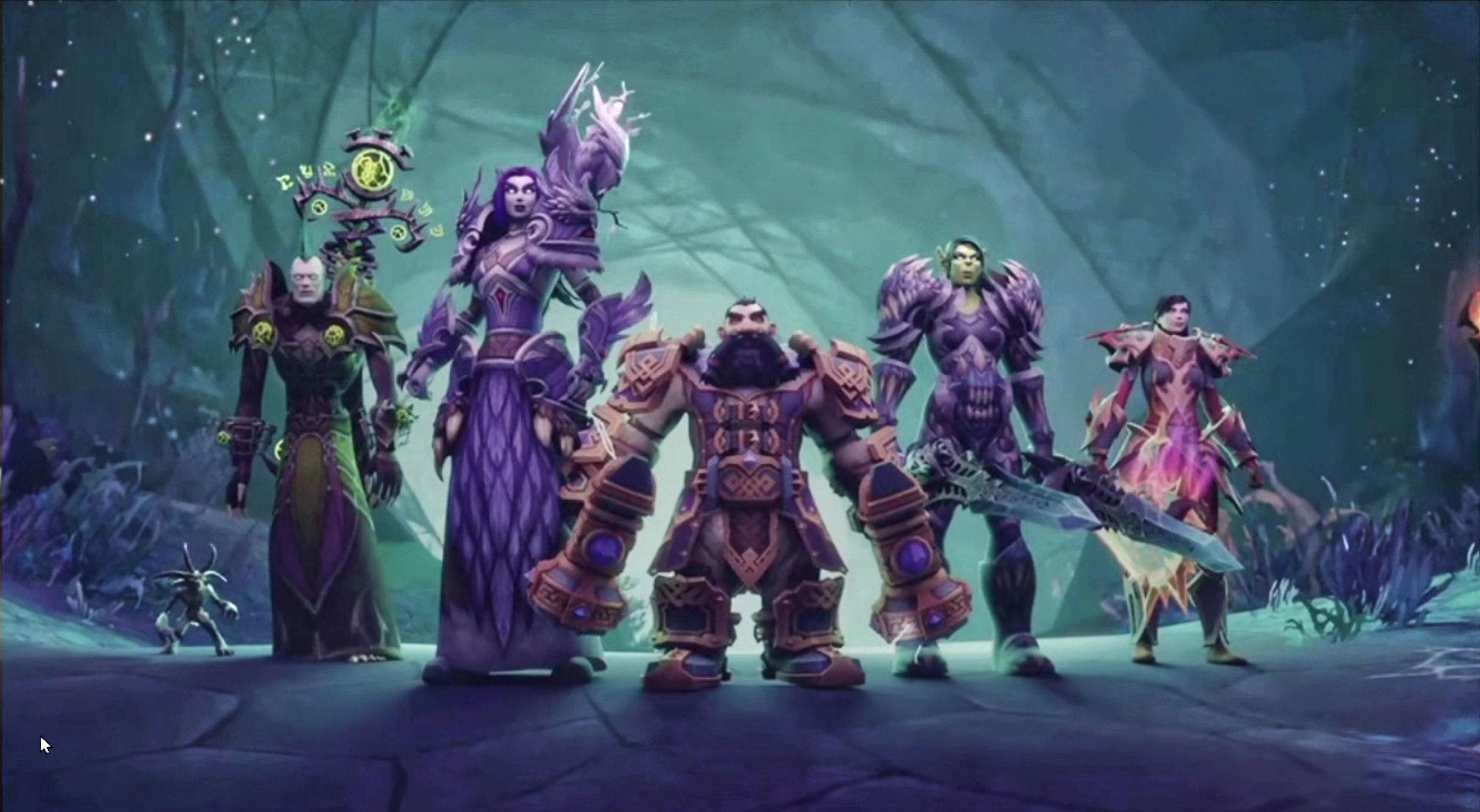
For those of you who have played it, I’m sure that you can attest to that. It’s been this incredible experience that has continued to build on itself and become something even new from where we started out, and part of the reason for that is as we release new expansions over and over again and increase the story or expand the story and add new zones and new continents and allow players to go to space. I mean, it’s been pretty spectacular, the journey that modern game has been. But we recognized a little while ago, back in 2017, 2018, that where the game is now was really far from where we started back in 2004, 2005. And through substantial player demand and then a lot of internal demand as well, we launched something called WoW Classic in 2019.
WoW Classic was incredibly special for us and for our players. It was something that even internally we wanted really bad to explore. And the company was very hesitant about it. We were extremely nervous when we did it. We did not know how players would respond. But WoW Classic was essentially taking that original 2004- 2005 era game and returning to it. And the players trusted us so much that they even came up with the hashtag # NoChanges. Which was it? “Blizzard, please do not make any changes. We want this game to be exactly the way that it was back in 2004-2005.”
Holly Longdale: It was insane! There was like one lamp on a roadway that had a broken texture in Vanilla, and they made us change it to its broken state.
Clay Stone: Accuracy. Totally. And thank you for reminding me of that. The way that players, and we have referred to this as the vanilla game – that original version. And if anybody remembers this, when J. Allen Brack announced it on stage at BlizzCon, he said, “Some of you like vanilla.” And it was a big moment. I was watching as a fan at the time, and that was a really big moment.
Holly Longdale: Do you remember– we made the combat objectively worse. Like we put delay in it so it would feel like 2004. So there were definitely some things that we thought, okay,m well, it is accurate. It’s no changes, and players should like… yeah. I don’t know. Maybe, maybe not.
Clay Stone: But at least a start. Yes, that was where we had to start from, for sure. And we’ve gone on from there. Obviously, as we mentioned, WoW Class of 2019 blew us away. Expectations-wise. I mean, that was- Holly loves to use the word– this particular word, but only in specific situations, and I know when she says it, she means it. And that word is: “Unprecedented.” And it was. It was unprecedented for us.
Holly Longdale: That does happen because I’m a data nerd. Like, I do all kinds of research. And so when I do say it, I can back it up.
Clay Stone: Absolutely. And so, from that success and player interest, we then went forward from there. We released the Burning Crusade Classic, bringing back that amazing expansion again a couple of years later. Then we released Season of Mastery, and Season of Mastery was that vanilla game, but for the first time, us experimenting with a couple of little changes, mostly from player demand. There was something in there, which I’ll touch on a little bit a little bit later, called the Soul of Iron, that led to something much bigger.
But it gave us the ability to say, like, okay, you know what? We can actually make a couple of changes here. And that progressed; of course, we then released Wrath of the Lich King Classic, and then we released World of Warcraft: Classic Hardcore. And that was in 2023, and as I mentioned, that Soul of Iron was our first little attempt at putting something in the game that basically said, for players who want to, could they go all the way from level 1 to level 60 without dying, because death was permanent. And death meant you died, and you had to go again.
And the response to that blew us away. That was the moment when Blizzard and the community really came together outside of the original Classic 2019 launch. And we said, okay, we can build something almost entirely new, or that feels entirely new. You know, visceral, the world is extremely important. You have to pay attention to your surroundings. Because, for those who don’t know, you die a lot in regular World of Warcraft. A lot.
So for those of you who have completed this level 1 to 60 journey, I salute you.
Holly Longdale: The videos are the best. When you peek around a corner and there’s somebody of the opposite faction, people freak out, like absolutely lose their minds and run away, like: “Retreat!” Spectacular, but that is sort of that connection to the world itself, and that’s where there are high stakes; you get those really awesome emotional moments.
Clay Stone: Sometimes after work, I’ll just sit at home at night, put on a little YouTube, watch some Hardcore deaths. I mean, I feel bad, but it’s entertaining.
Holly Longdale: (laughs) It’s a little sick, Clay.
Clay Stone: I’m not alone. Right?
Holly Longdale: No, it’s great. It’s fantastic entertainment.
Clay Stone: So that was WoW Classic Hardcore. And then a mere few months later, we announced and released World of Warcraft Classic Season of Discovery. And you want to talk about moments where the team kept pushing and going bigger and trying new things, progressing from Hardcore to WoW Classic Season of Discovery– that was a big moment. We’ll talk about it again in a little bit but that was a big moment for sure.
And then, of course, came Cataclysm Classic shortly after that, followed by- gosh, I can’t believe this was back in 2004- we re-released that 2019 game again; that was what players called Classic Fresh with WoW Classic 20th Anniversary Edition. And you can see a little baby of the 20th Anniversary Edition Hardcore because we re-released Hardcore again. Only this time, Hardcore players got through the rest of the content at the same time as the other players.
And then not long after that, of course, came Mists of Pandaria Classic, followed by our Titan Reforged realms for our players in China. Something to note on that too: even though that game — we developed it, and we released it only in China, we have learned a lot from that as well.
Similar to all of our other releases that we’ve done so far, we’ve really taken a lot of those learnings and even applied some of those learnings to World of Warcraft: Forever, too.
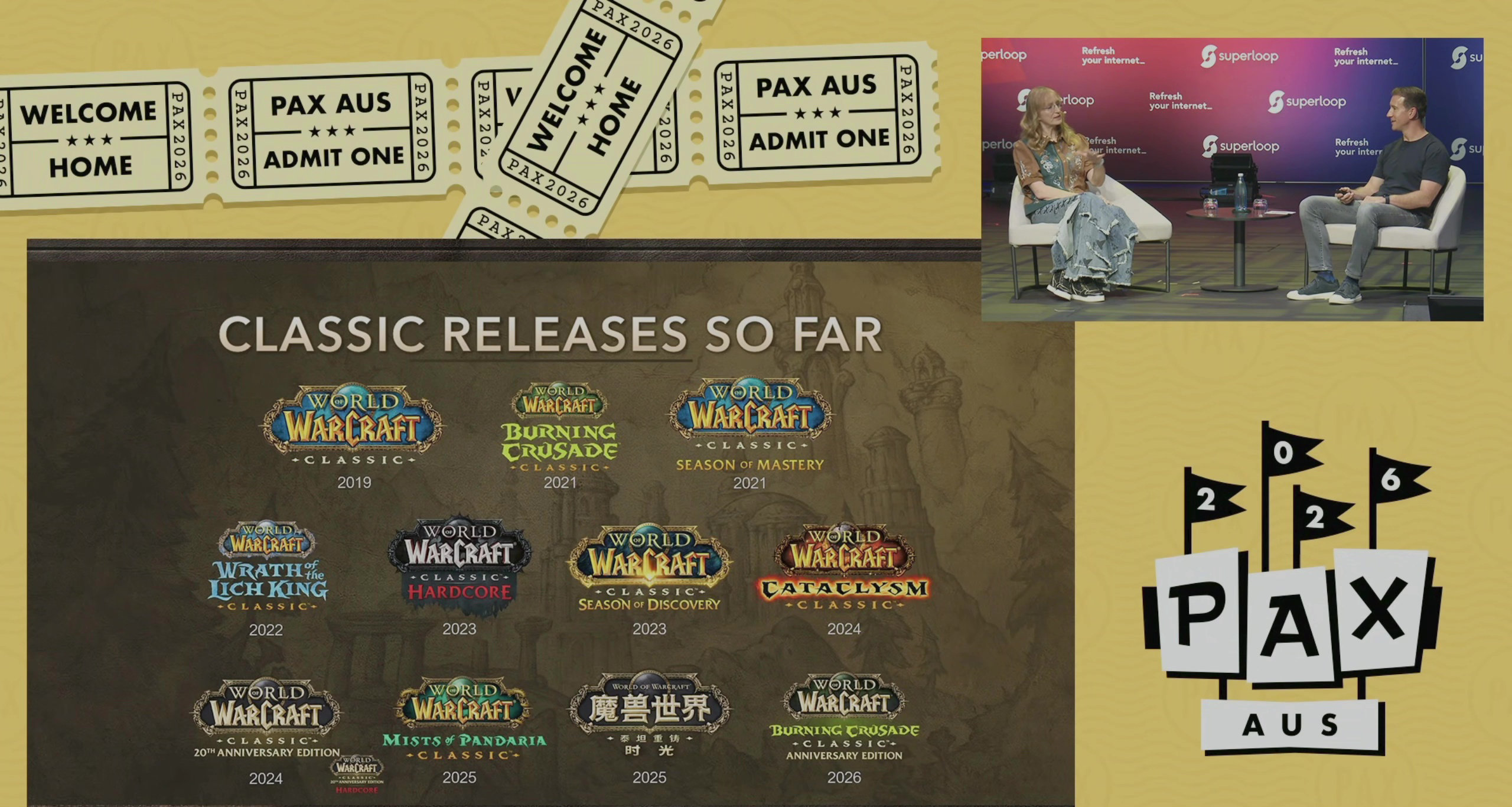
Holly Longdale: And it’s great seeing this list because it is a lot of what the community asked for. And so we were like, let’s try a season (like Season of Mastery or Season of Discovery) where we can test this idea, this notion of Classic+? And those are the things we kind of fought for because it was such an outlier for Blizzard and for World of Warcraft, but it felt like the right thing to do.
Clay Stone: Totally. We look at each of these, including most recently returning again to Burning Crusade, which again completely exceeded our expectations. But for each of these, you’re 100% correct. We have been guided to where the players have told us that they have wanted to go.
So that leads us to the next topic that I want to talk about, and that is Greenlights. So, for anybody in here who might not be aware, at Blizzard, we go through a greenlight process. Very similar to many other game studios out there. And essentially, what it is, it is a series of checkpoints, usually between the development team and studio leadership, providing studio leadership the ability to be able to ask us questions, discuss any concerns that they might have, really help make sure that we’re all on the same track, and where all systems go for the next stage of the Greenlight process.
Very critical that we make sure everybody’s aligned on this. So I’m going to show something that I’m a little bit nervous about because we’ve never shown it outside of Blizzard before, and that is our actual pitch slides for World of Warcraft: Forever, before it was even called WoW: Forever. You may be asking, Claire, are we really doing this? Yes, we are really.
We are really going to do this. Okay, so, before I jump into this, the only thing to note, these are the actual pitch slides. The only changes that we’ve made to them are like a couple of tiny formatting changes. And then I included one slide that came from a slightly later greenlight — which kinda summarized everything, but otherwise, this is it. This is the same content.
We started by talking about the WoW Mythos. We wanted everybody to align on this. And what is the WoW Mythos? Well, over the past 20 years, a mythos has developed in the community about the unfinished content of the original vanilla WoW. We’re talking about things like raids, dungeons, zones, battlegrounds, incomplete storylines, unused characters, and the list goes on and on.
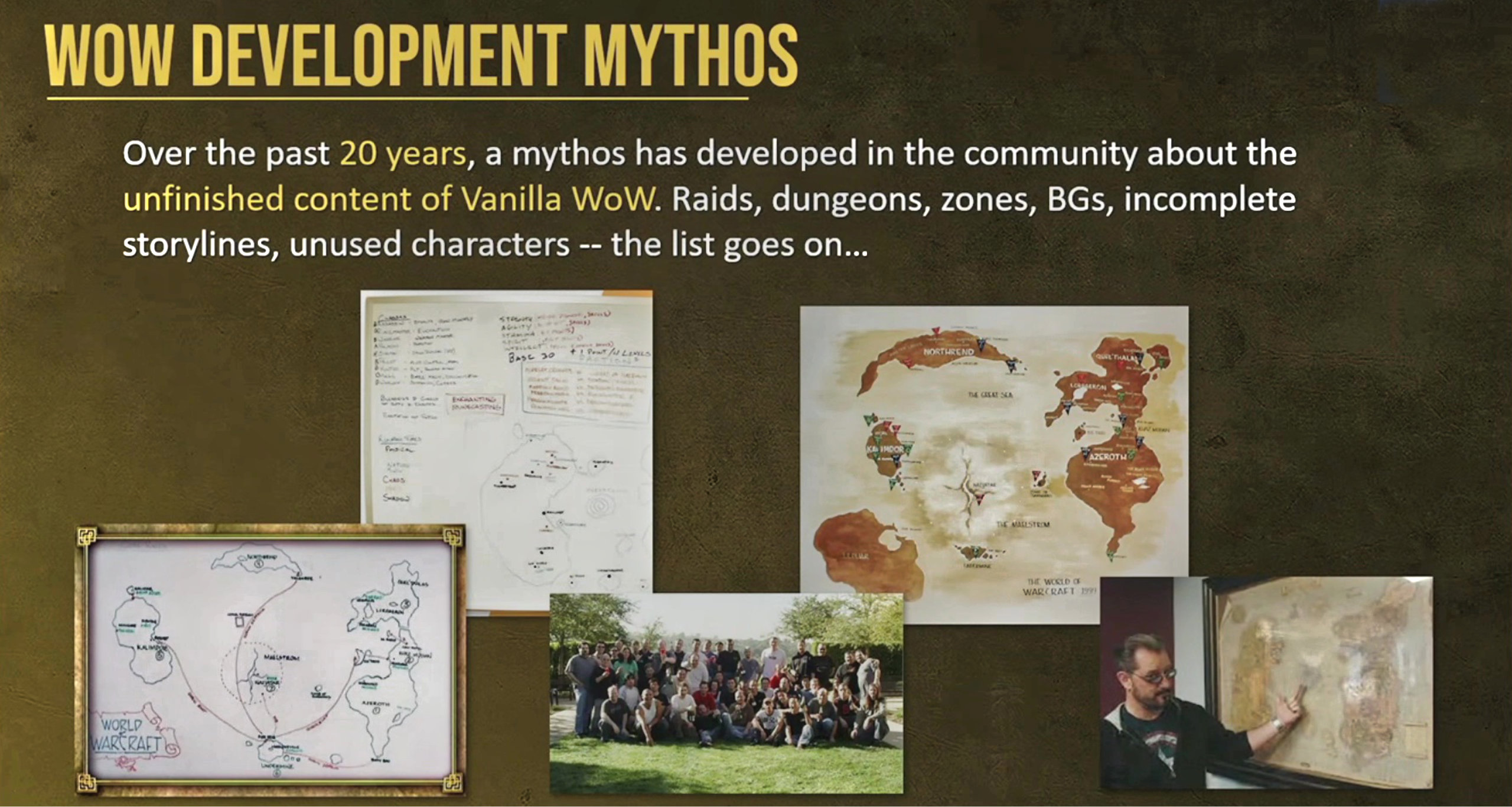
And players remember all this, and we know that they remember all this because they love to post pictures of the original development team online, including pictures of Chris Metzen pointing at maps of Azeroth, which were painted on the wall at Blizzard, and I think some of them still are. So of course, we knew that this discussion had been in the community and it is been in discussion for a long time. What players were talking about, of course, was this treasure trove of unfinished content, which existed within the community consciousness.
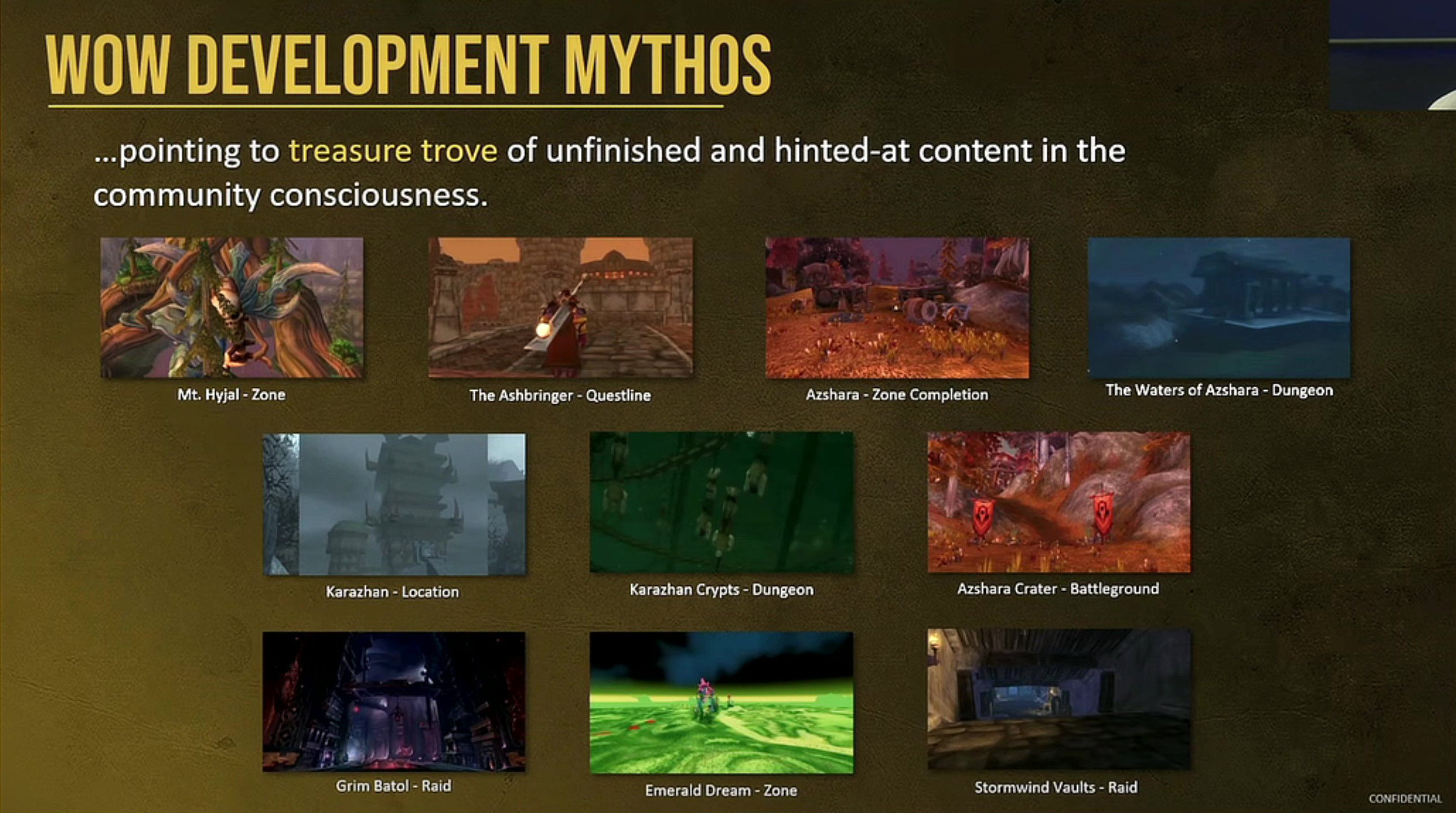
And some of this, I think, folks hopefully in this audience are aware of, which we later pursued in things like Season of Discovery, like the Karazhan Crypts. We are doing a Scarlet raid. But all of this existed within the player consciousness. Even for players who did not play back in 2004-2005, the discussion online was so prevalent that for players who didn’t even experience it, they felt like they were nostalgic for this content themselves. It’s like a vicarious sense of nostalgia through other players. But it was there. It was in the psyche for sure.
So the combination of this expansion of content in Classic Azeroth, mixed with changes grounded in the design ethos of “classic” Classic Azeroth, has created within layers an ever-growing conceptual dream of Classic+. Aka … a vision of Classic Forever.
And before we go on from there, I should just note that when I say conceptual, I underline that word specifically. Because if you ask 50 different Classic players what Classic+ means to them, you are gonna get a hundred different answers. And I think we talked about it a little bit at BlizzCon, too. So it’s hard to define and align on exactly what Classic+ means, but it is some combination of these things, and we are pretty confident in that. So we revealed Season of Discovery back at BlizzCon 2023. You can see Holly up there on stage announcing it, and we launched it just four weeks later.
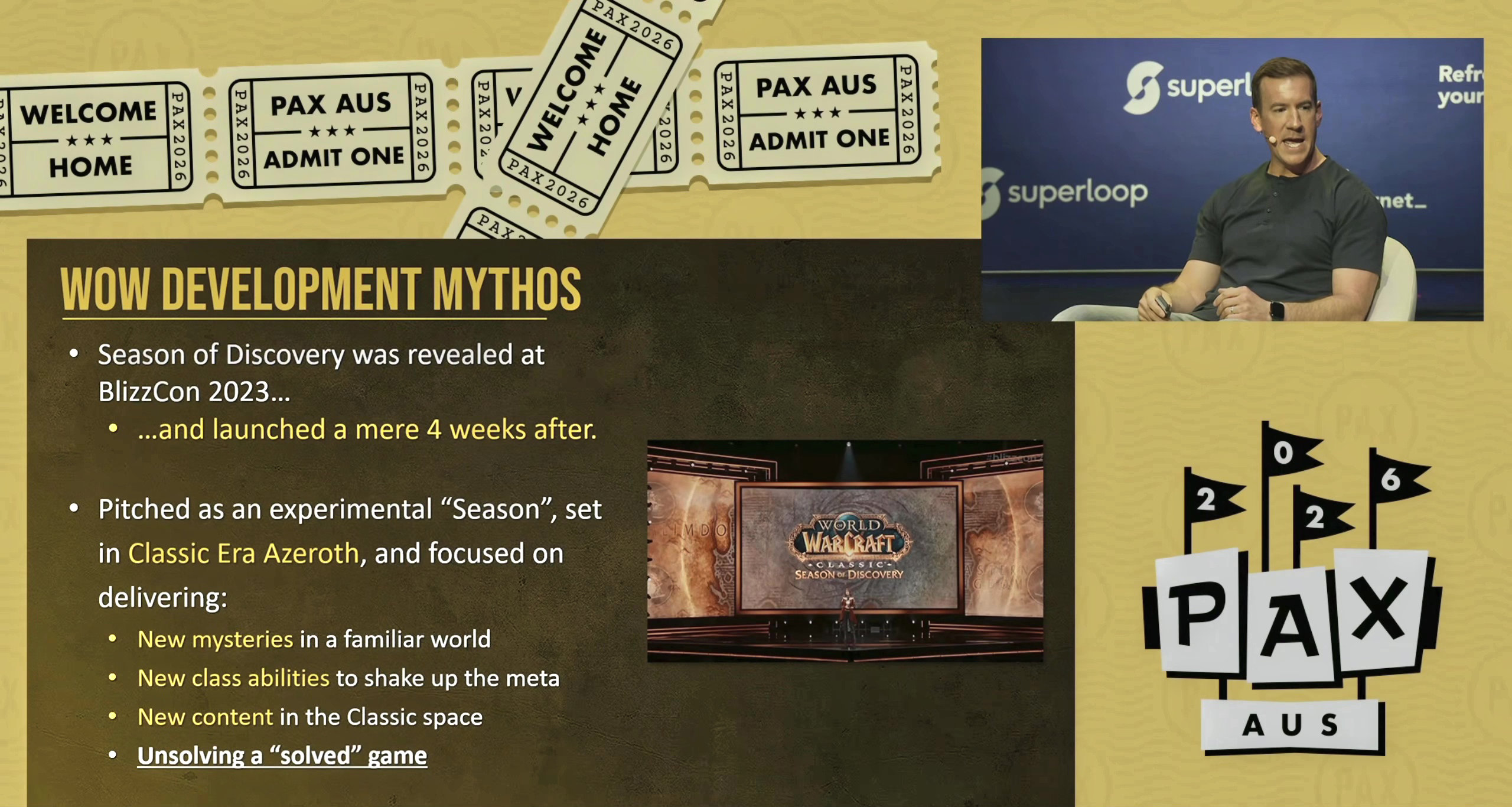
And we pitched it as an experimental “Season.” We set in in classic era Azeroth, and we focused on delivering new mysteries in the familiar world, new class abilities to shake up the meta, new content in the classic space, but most importantly, unsolving a solved game.
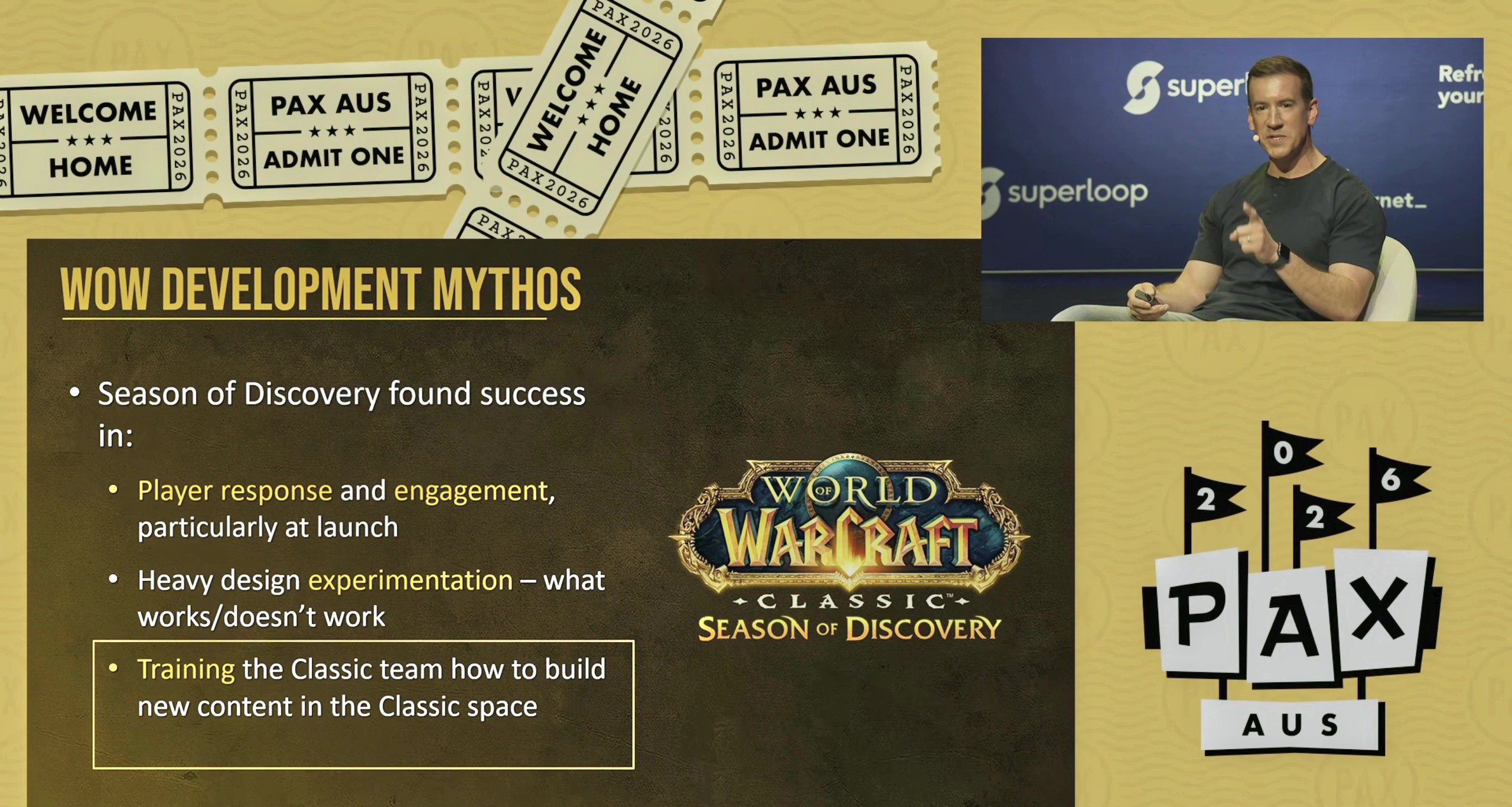
And Season of Discovery found tremendous success in things like the player response and engagement, particularly at launch. The heavy design experimentation. So what works, what doesn’t work? For anybody who plays Season of Discovery, I think you’ll agree we pushed classes pretty far in that. But most importantly, at least as I sit up here today in the discussions that we have, it trained us as a classic team and a greater World of Warcraft development team how to build new content in the classic space, which was critical.
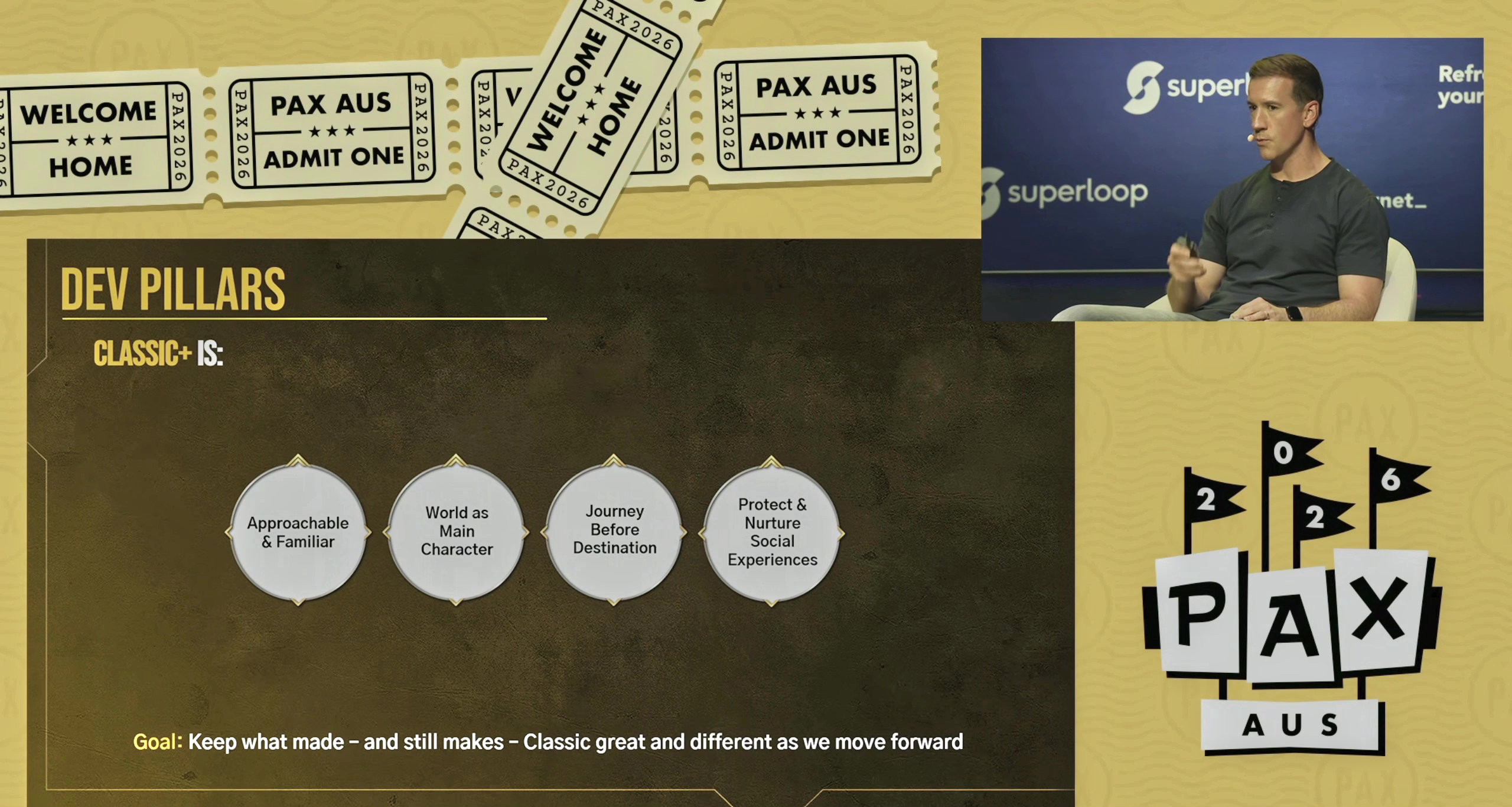
All that being said, this is when we transition into Classic+ as part of the Greenlight process. Classic+ is, this is how we described it, it is approachable and familiar. We want players to be able to enter the game, whether they have played it or not, and feel like it is approachable, just like that original game in 2004-2005. And for players who have played it before, we want it to be familiar, meaning that any of the content that you experience in the game should feel like it could have potentially launched back in 2004-2005. Feels seamless.
It’s also the world as the main character. The world of Azeroth is the thing that we fell in love with in the first place. And if you remember those days in 2004-2005, entering this gigantic, mysterious world that seemed almost endless, that was a core pillar of ours that we wanted to preserve.
And then next, we had the journey before the destination. For as epic as Endgame is, and I think I mentioned that, I promise you it will be epic. That 1-60 leveling journey is something that is only found in Classic, and we wanted to make sure that that was a pillar of every decision that we made for this game.
And then lastly, we wanted to nurture and protect social experiences. Classic is incredibly social. It is impossible to do literally everything in the game if you don’t at least talk to somebody else. So all of our decisions- we’ve talked about the things which we talked about at BlizzCon, things like camping- and hopefully some of you playing the beta right now have experienced that; those ideas were born out of this. But these are the design pillars that we use any time we think of making a change or adding some new piece of content to WoW: Forever. But the bottom line is that we wanted to make what made and still makes Classic great and different as we move forward.
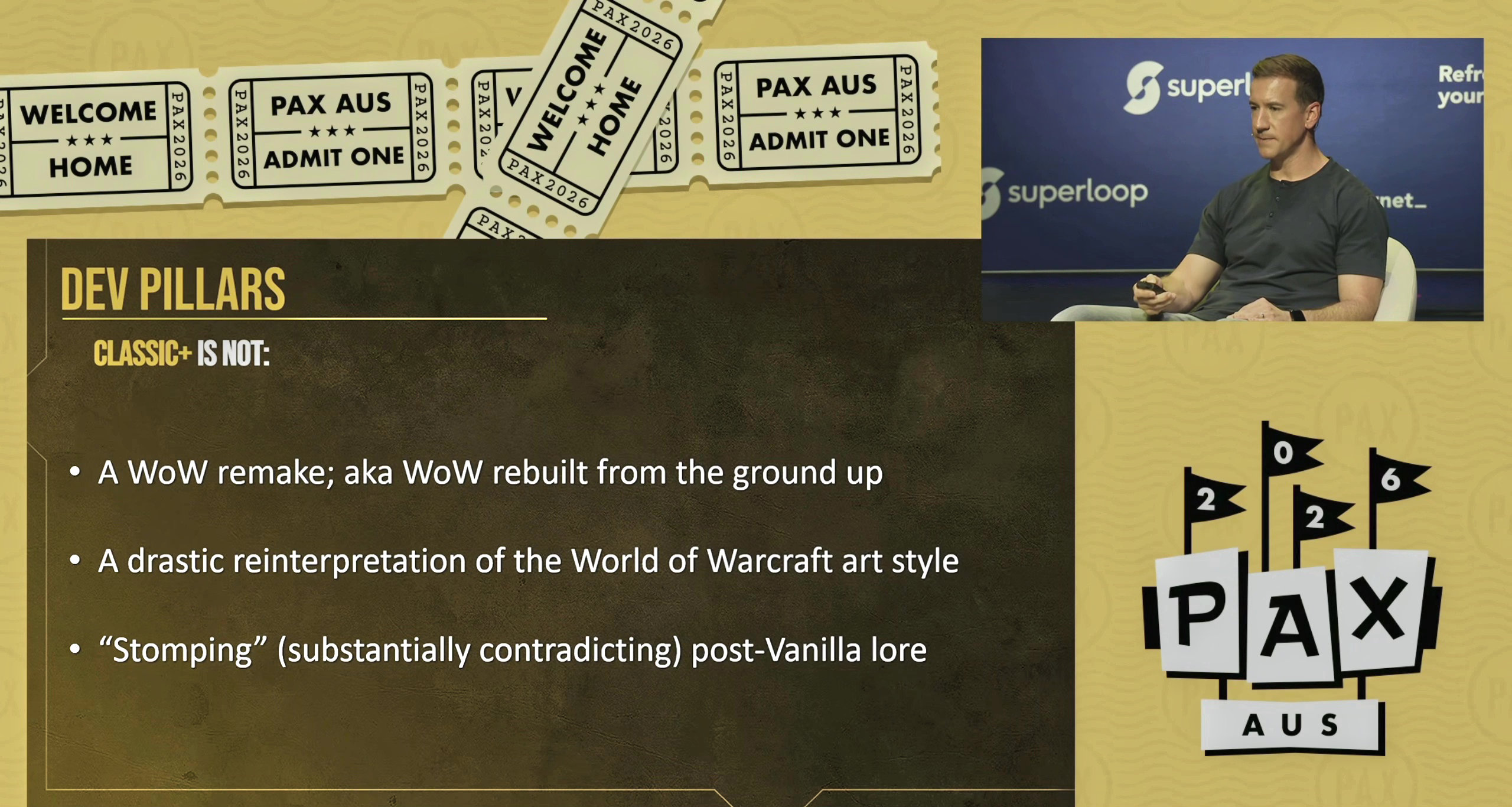
So just as important as Classic+ is, let’s talk about what it is not. Obviously, very important for us when we are pitching this thing. We’re not saying it’s everything for everybody. What is it not? And the first thing is that it is not a WoW remake. Aka is not WoW rebuilt from the ground up. It is the same WoW that you know. We’re not changing the combat or the way that works. We are grounding it in the things that made that original game so successful.
Secondly, it is not a drastic reinterpretation of the World of Warcraft art style. We love seeing the videos online of people recreating World of Warcraft in Unreal Engine 5. They’re very interesting, for sure. But I think, as we mentioned at BlizzCon, we believe that that Classic art style is timeless and something that we want to preserve, and that’s a key focus of ours.
And then, lastly, we don’t want to stomp on or substantially contradict post-vanilla lore. And I think what this grew into is, as we again talked about at BlizzCon, we are starting from a place of canon, but we are going to be existing in a time bubble, essentially in Year One of World of Warcraft: Forever, or as long as players want to go on in this journey with us — which will allow us to be able to tell new stories that feel authentic to that space but at the same time, not force the modern game to have an immediate reaction to things.
So we introduced our brand-new race: the Skyborne Elves. We don’t want the modern game to basically have to say, like: Well, here’s an answer for where they’ve been this whole time or things like that, or new dungeons that we introduce.
They may one day adopt that; that’s not gonna be up to me, but that’s the reason why we sort of exist in this space.
So then we talked about content, and our belief was that in addition to the existing vanilla WoW content, we would introduce new and expanded zones, new dungeons and raids, a new race, new Class updates, new reputations, new Professions content, new Items & Rewards, new Legendaries, and more! All with a persistent Level 60 cap… at Launch.
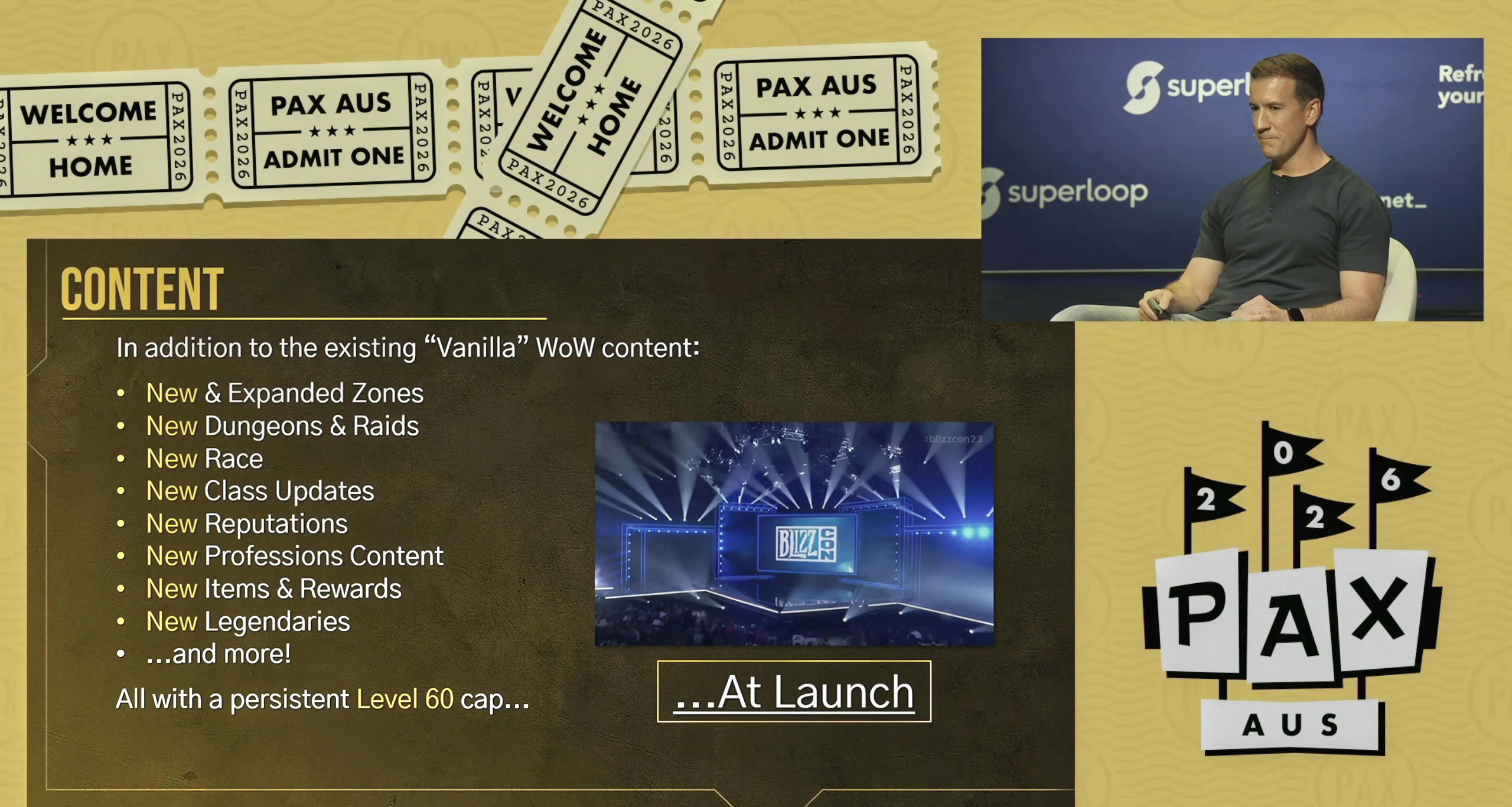
It is fun to revisit these slides now because even though we were confident we could do this, we didn’t know for sure. No. We were standing up in front of you and the rest of the Blizzard leadership team. These were the things that we were saying we could do. And we were pretty sure.
Holly Longdale: No. No. It was very much like– “Oh, hell no.” And honestly, this wasn’t that long ago. They just actually pulled a rabbit out of the hat, and this was a situation where we’re like, we’re gonna invest in you; we’re gonna get you the help you need, you know?! (public laughs) And they killed it, they smashed it, and it just– we had no idea it was gonna become what it has become. It’s become more than we could have planned for, just in how it feels. It’s amazing. So yeah. But I appreciate you going with at least the appearance that you believed it.
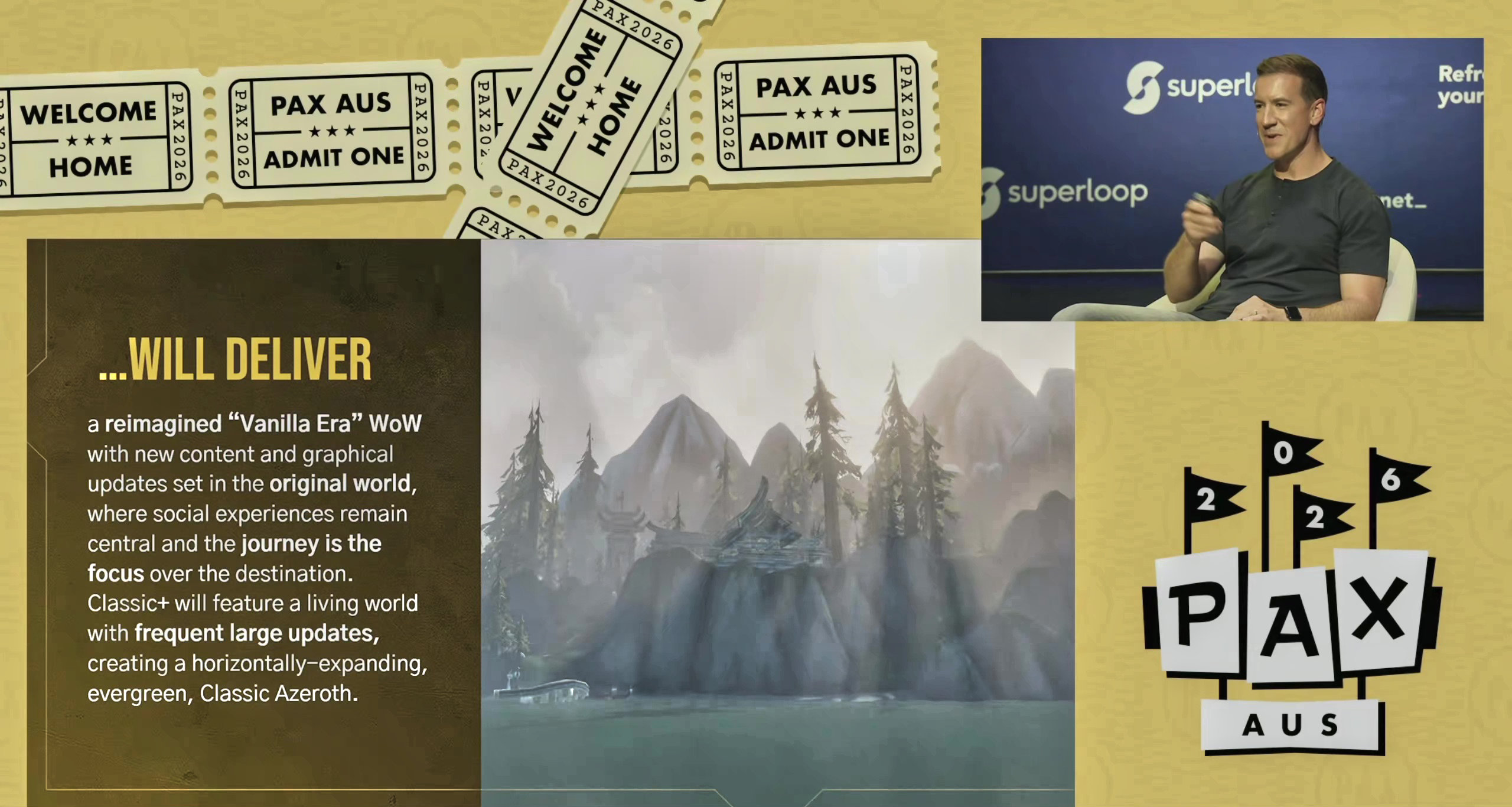
Clay Stone: As long as I looked confident in the room. Our belief was that the reveal of what we consider to be this dream content lineup at BlizzCon 2026- we were calling our shot- would deliver a reimagined vanilla-era WoW with new content and graphical updates set in the original world, where social experiences remain central, and the journey is the focus over the destination.
Classic+ would feature a living world with frequent large updates, creating a horizontally expanding evergreen classic Azeroth. This was that summation slide that I talked about.
Holly Longdale: That was the hell no part. They did it!
Clay Stone: So as important as that was, we also had to be able to communicate to the Blizzard leadership team how this is gonna fit into our whole ecosystem? We’ve already got Classic, we have already got Modern, and so what I put together were these Pringles cans. I’m not the best at PowerPoint, but I was able to make these shapes. I don’t know if you have got Pringles in Australia. I don’t know if they put–
Holly Longdale: Do you have Pringles? (crowd says: yes) Sorry!
Clay Stone: Okay. Alright. Good. Thank you. But what we essentially communicated was that Classic would continue. It would be its own thing. Classic would live on, and it would be as it was. And then, of course, we had the modern game with the modern team forging the best-in-class modern MMO with the World Soul Saga, and this new game would sit right alongside them as a new vanilla era forever.
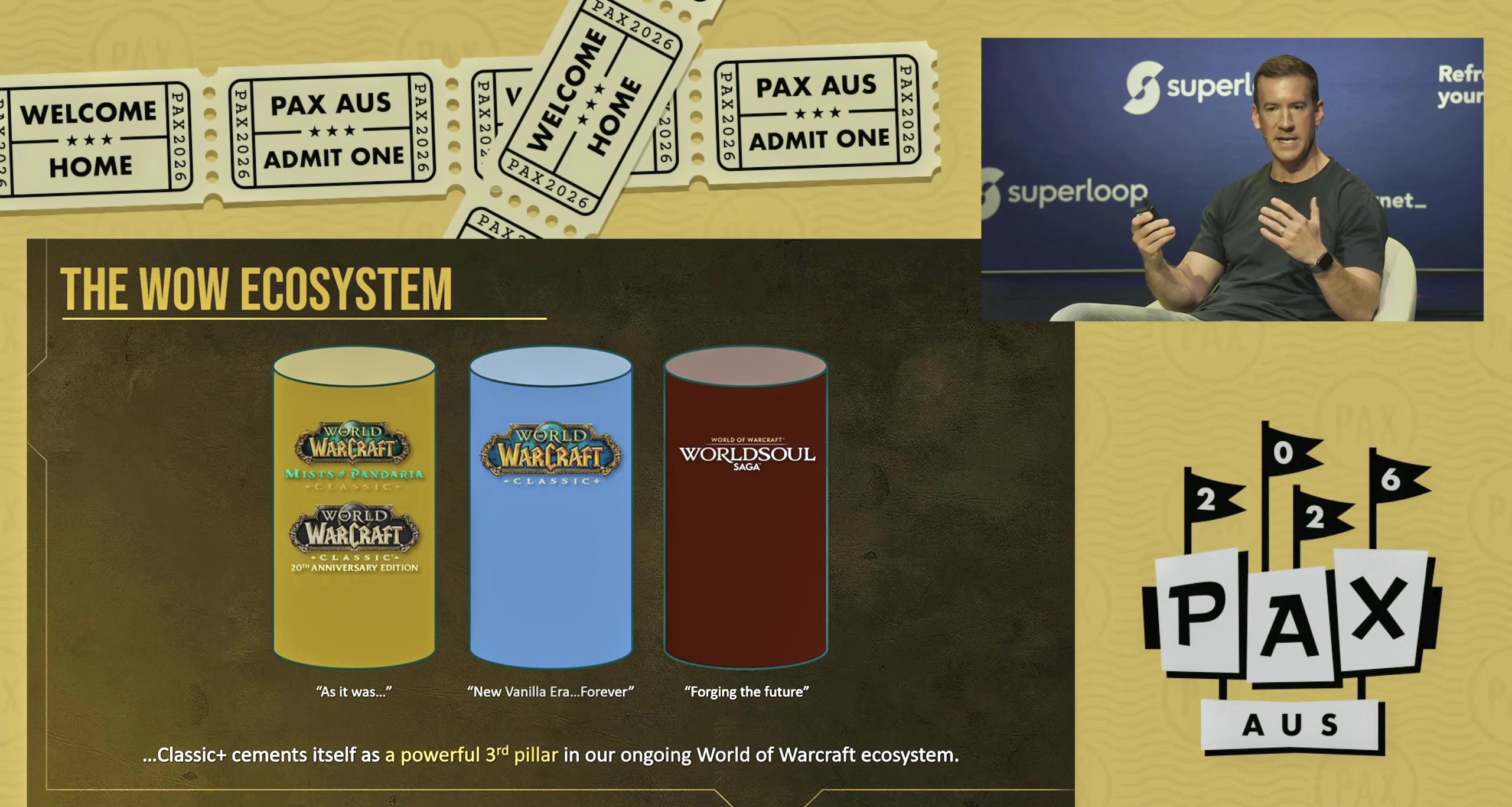
But the pitch is that it would be this brand-new third pillar of our ongoing ecosystem. And it is all available for one subscription, by the way.
Holly Longdale: Sales pitch!
Clay Stone: (smiles) Which, of course, brings us to World of Warcraft: Forever and where we are today. We’re currently in beta. Hopefully, many of you are playing our Beta right now. We just had a content unlock. I think it was this morning.
Holly Longdale: It’s insane. In our recorded history of Blizzard, there’s been no beta bigger than this, and people are playing it like it’s Live. Like, we make changes, we fix stuff, like I don’t regret that change. But it’s beta, so it’s kind of what we do. We kind of break stuff, fix stuff. We’re delighted, and I don’t think we were ready for this kind of engagement. We hoped. You always hope. You always hope you get that lightning-strike moment. You never expect it; that’s like, don’t do that to yourselves. But this is magic. Absolute magic.
Clay Stone: It’s been a fun ride already. Let’s take a minute, and we’ll talk about World of Warcraft: Forever, and then I want to show some really cool stuff that I don’t think much folks have seen. So we started, of course, with the original map of vanilla Azeroth, and as we revealed at BlizzCon, we have added to that in a whole bunch of different ways by expanding the world out.
Holly Longdale: MS Paint art. You know it’s legit when MS Paint has been used. That’s real developer graphics.
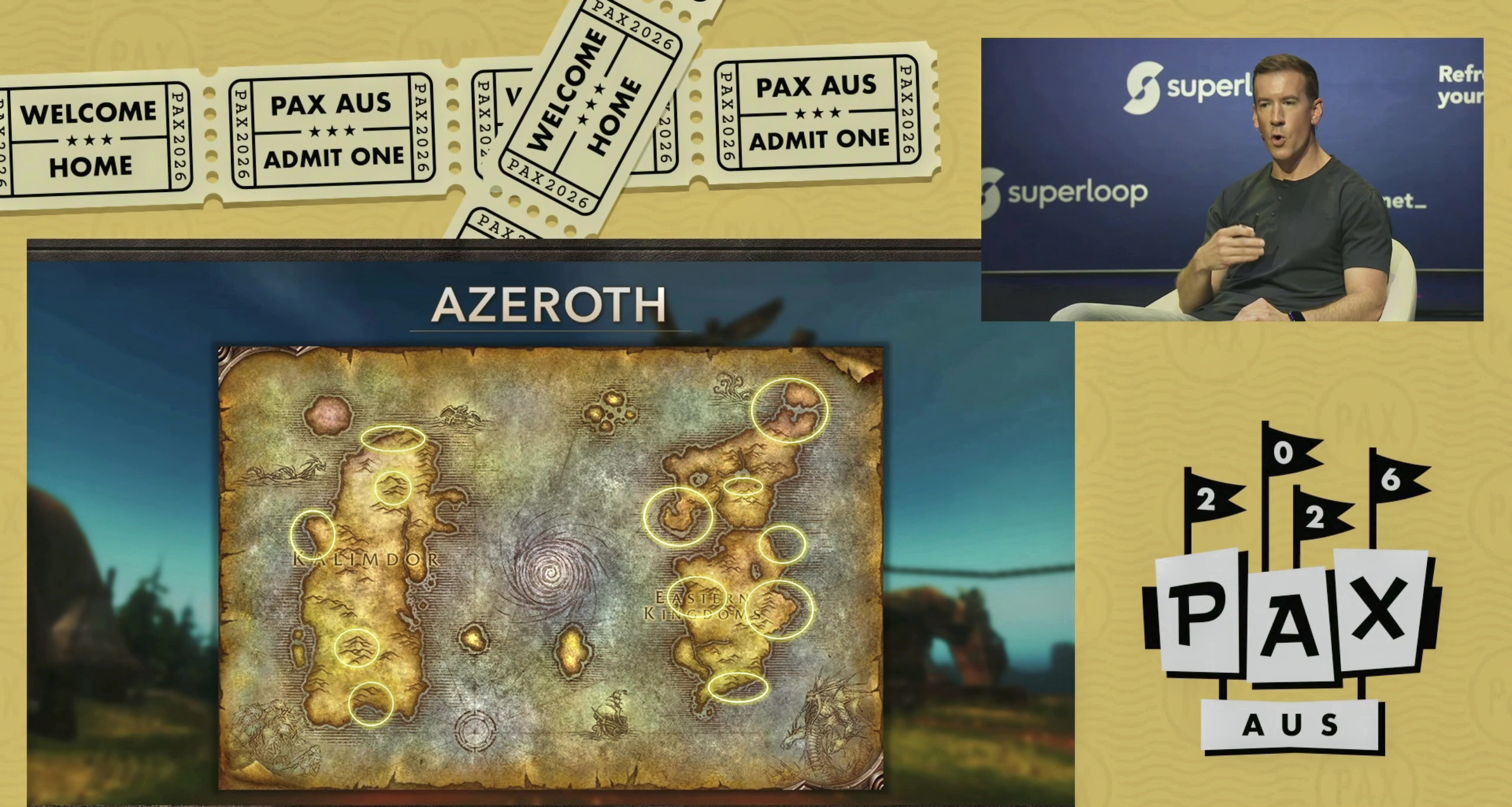
Clay Stone: Get ready. You’re gonna see more of that in a sec. And one of those areas that we developed is our brand-new zone called the Riverglades. You’re not supposed to go there now, but I’ve watched the beta, and I know some players have found their way in there through large, large parties, which is fine, but they’ve gotten to experience a taste of this. So I want to take a second to talk about Riverglades.
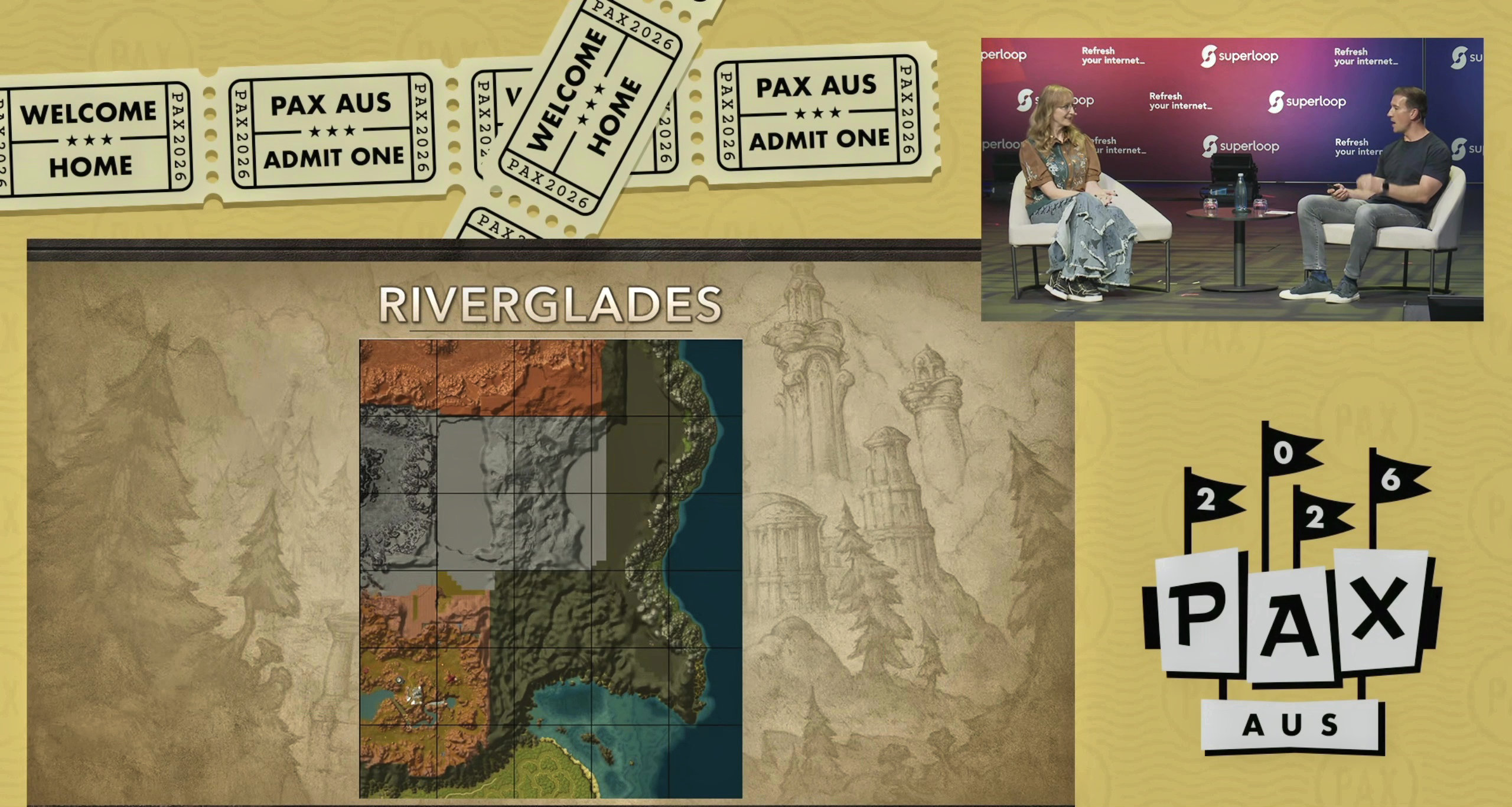
So the Riverglades existed; this is a look, a space-eye view of the vanilla game and the vanilla map of the area. And what we did was we took that area, and we talked with our concept artists, and we said: “Hey, we’re thinking we want to do a zone like this. It’s going to contain these elements; it’s going to be located here; we want to have these sort of biomes, and then our amazing artists create an image like this that then we use to be able to inspire the whole team around what the vibe is going to be like for this zone.
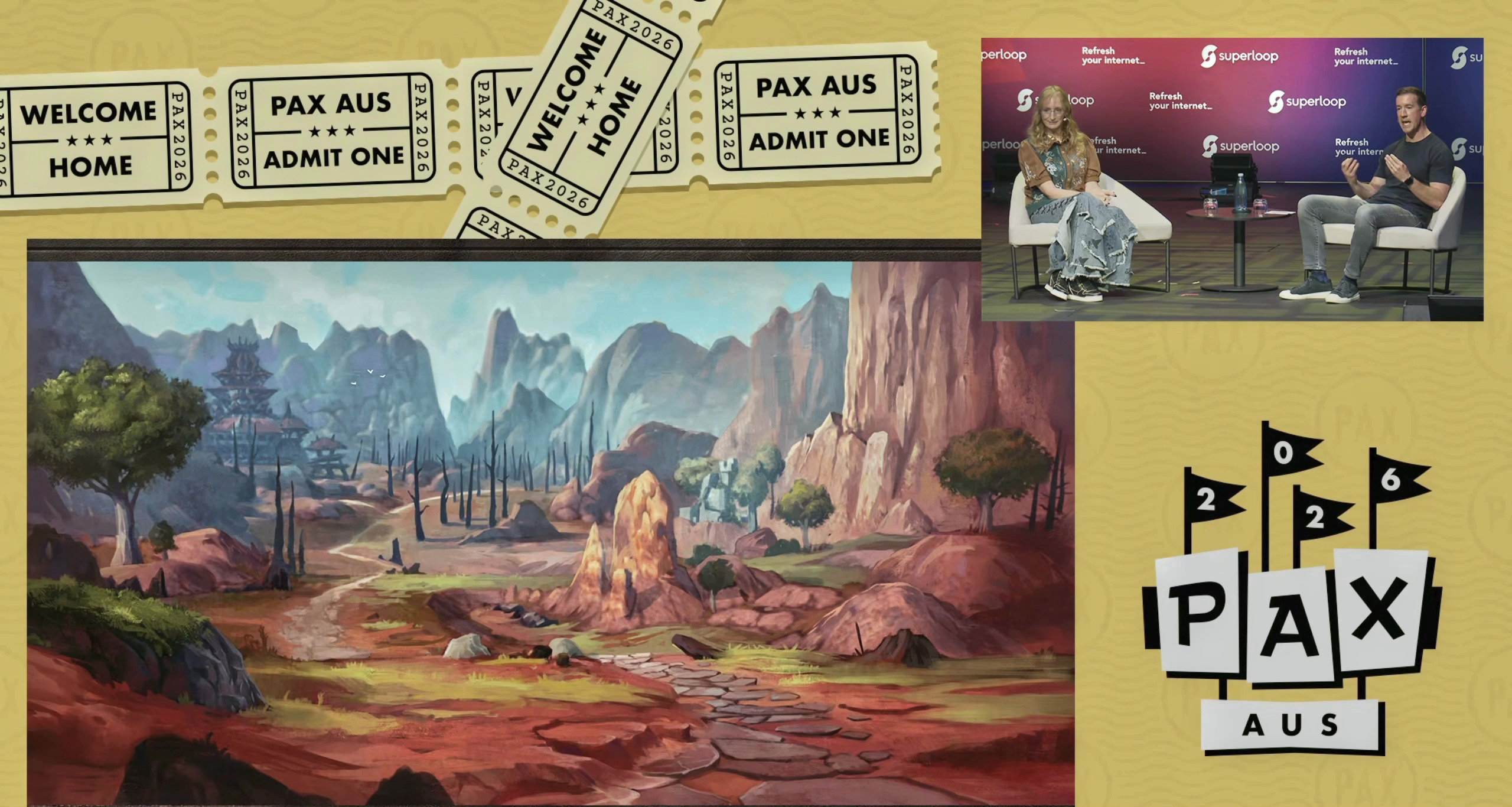
And then we return to that original vanilla map, and we work with our worldbuilders, and they worked their magic, and they transform it into something like this.
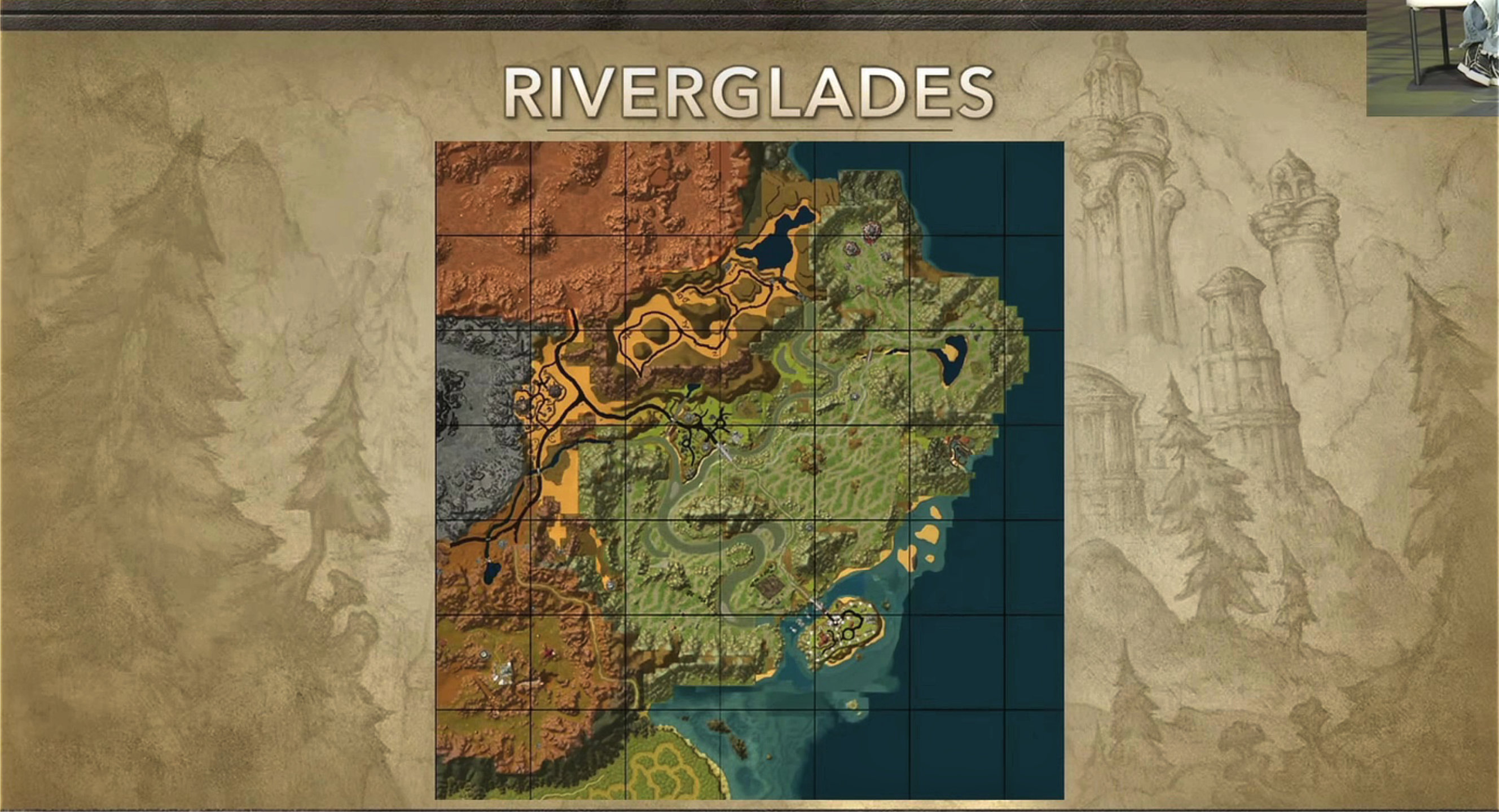
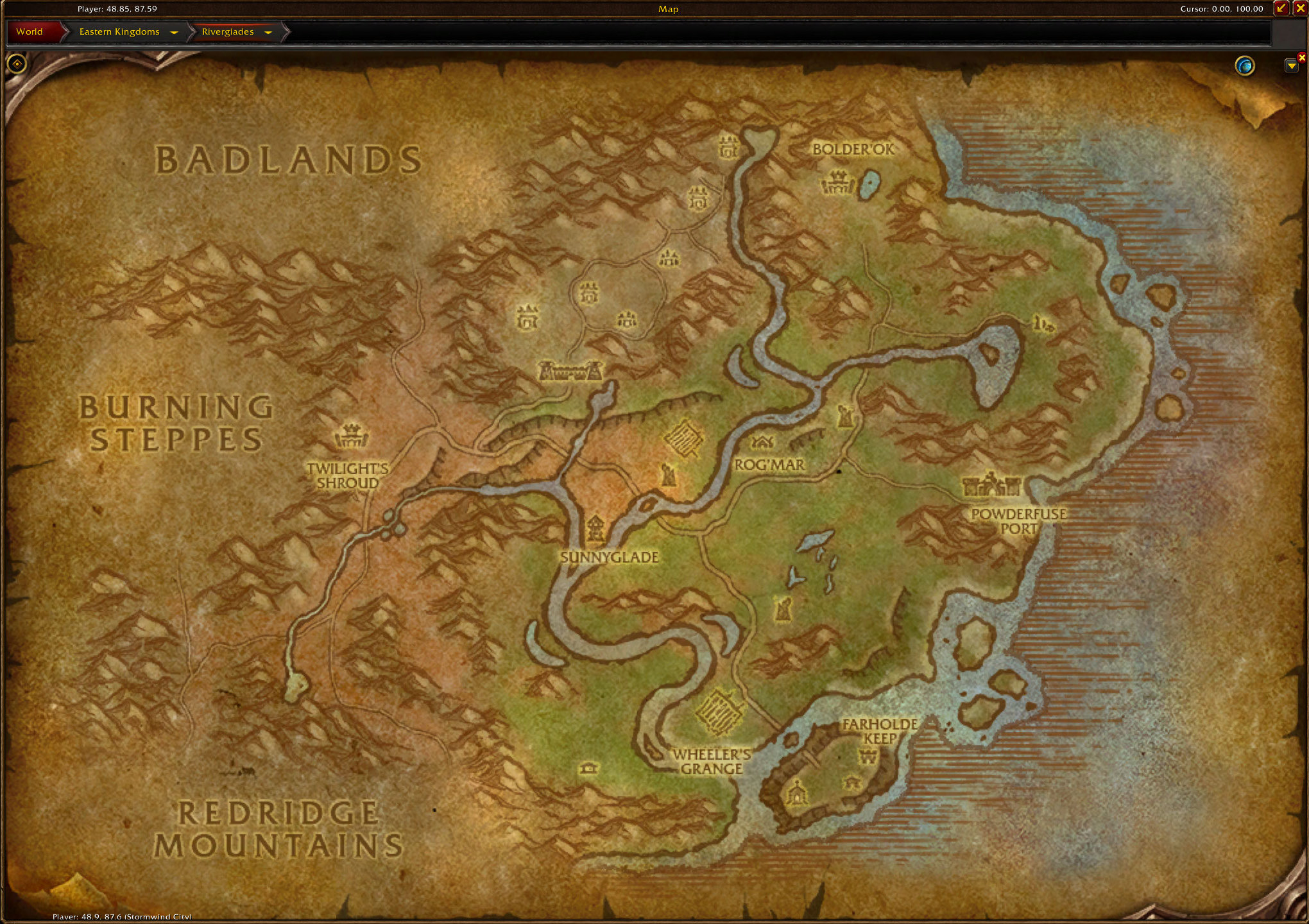
So, a space-eye view of what the Riverglades looks like in our new World of Warcraft: Forever map of Azeroth. So the Riverglades is located in the Eastern Kingdoms, that’s one of our two continents, and this is what it looks like with the actual in-game map, the finalized version of it.
And this is what it looks like once it was complete, at least one section of it. Although I do have to note, the Riverglades is massive. It is a whole new place; it has a whole bunch of new questing content that is part of the over 1000 new quests that we’ve added to the game, and we’re excited for players to be able to be able to experience it at the appropriate level once we launch the whole game. And it kinda fits into the way that we talked about adding new content to the game, too.
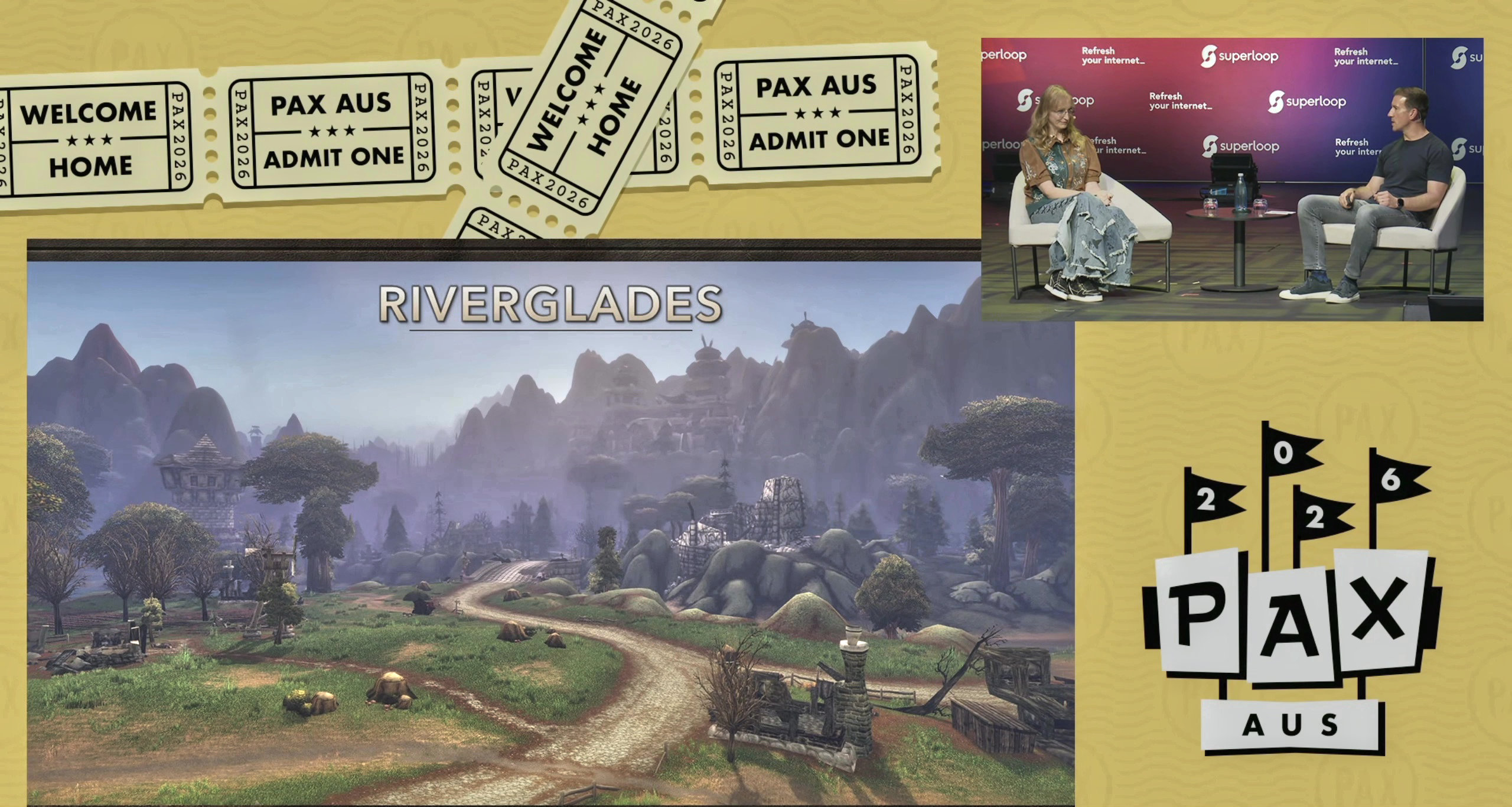
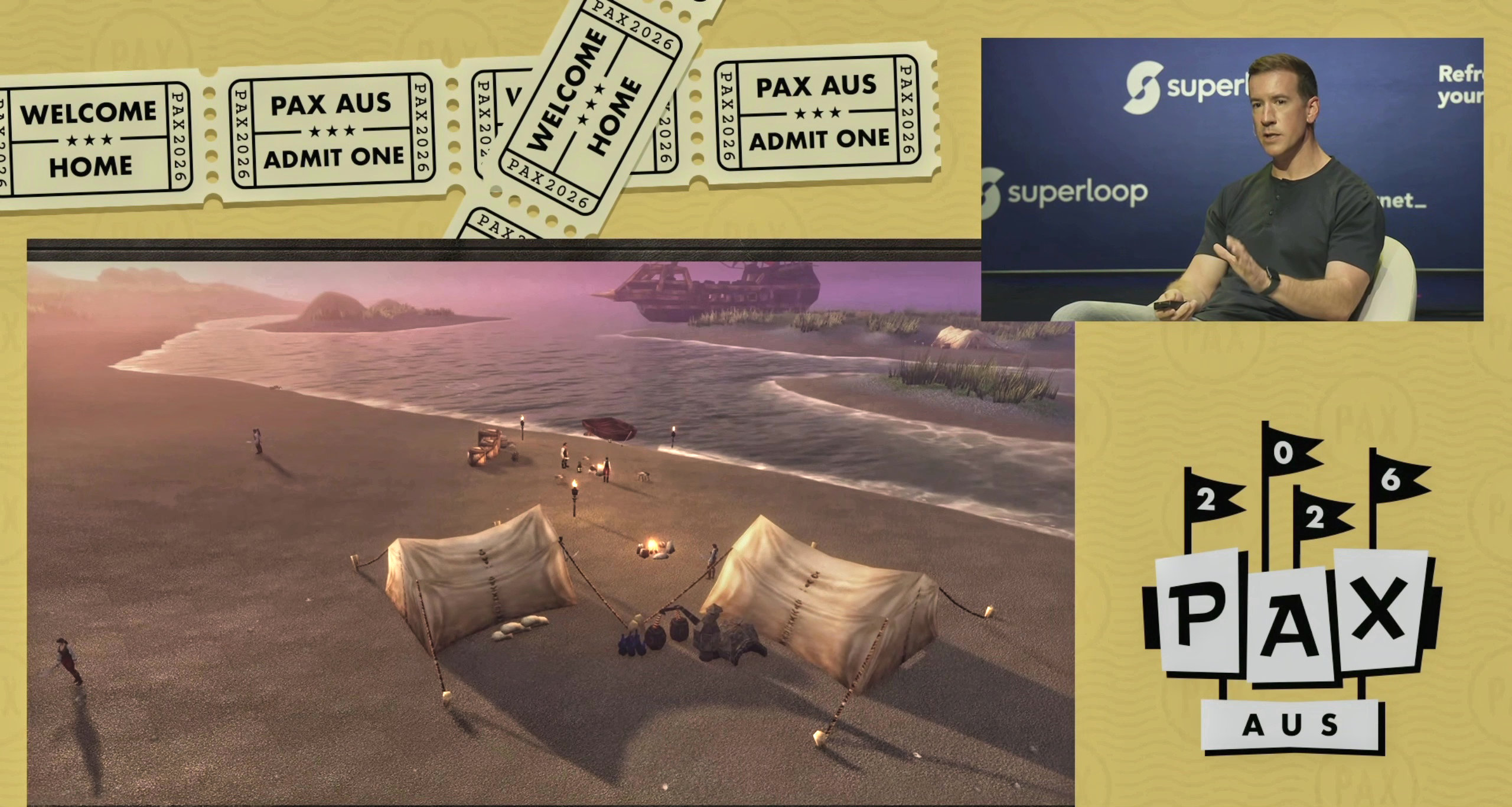
There is sort of three buckets that things fall into. There’s the expected, so when players dream of Classic+, they think of places like Mount Hyjal, of course. And then there is the completely unexpected, a little bit more high-concept, like Zephrys Isle and the Skyborne. But we love this because this fits right in between the two.
Feels like it fits seamlessly into that original vanilla era WoW. If you’d never played the game before but you came in, you would feel like, “Oh, this fits perfectly into it.” But no one was expecting something like this with Riverglades.
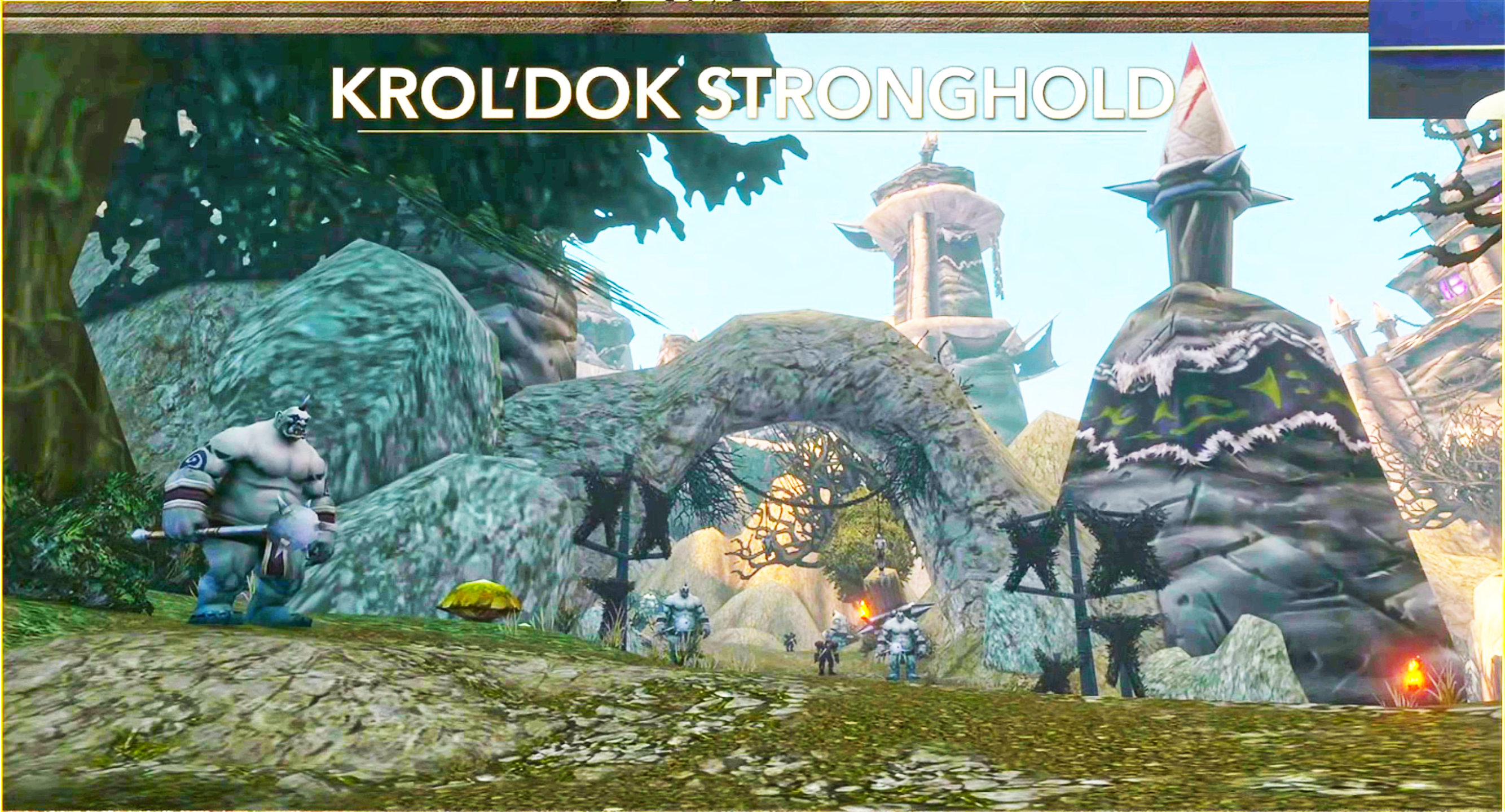
Let’s talk about Krol’dok Stronghold. So Krol’dok Stronghold is one of our new dungeons located in the Riverglades. We’re very excited for players, of course, to check this out. And what I want to do is take us on a little bit of a development journey for how we developed Krol’dok Stronghold.
For any of you who may know about our dev cons that we’ve been doing, which we could spend an hour on, we have the great fortune, with World of Warcraft: Forever, to release a weekly podcast. And it just so happens that today’s episode of the podcast was all focused on our dungeons. So shout-out to that group because they talked about a little bit of this in there.
One of the things that they talked about was how we basically did a dungeon blitz. Like an idea blitz where we said, okay, we think we can build this many dungeons. Originally, I think we said we could build six dungeons. Spoiler alert: we ended up building nine.
We just had too many really good ideas. And this sort of was born out of that process, and from where we started from, this is a gnoll. It’s a creature that many classic players and World of Warcraft players are extremely familiar with. Gnolls are extremely vanilla WoW-coated. Let’s do a gnoll dungeon. That’s a great idea. And at first, we’re like, of course, that makes perfect sense. And then we realized we’ve kind of done a lot of gnoll stuff. Well, what else would be a creature that would make sense but also feels very vanilla WoW-coated? Of course, we said Ogres. Ogres make sense. Ogres would fit right in there.
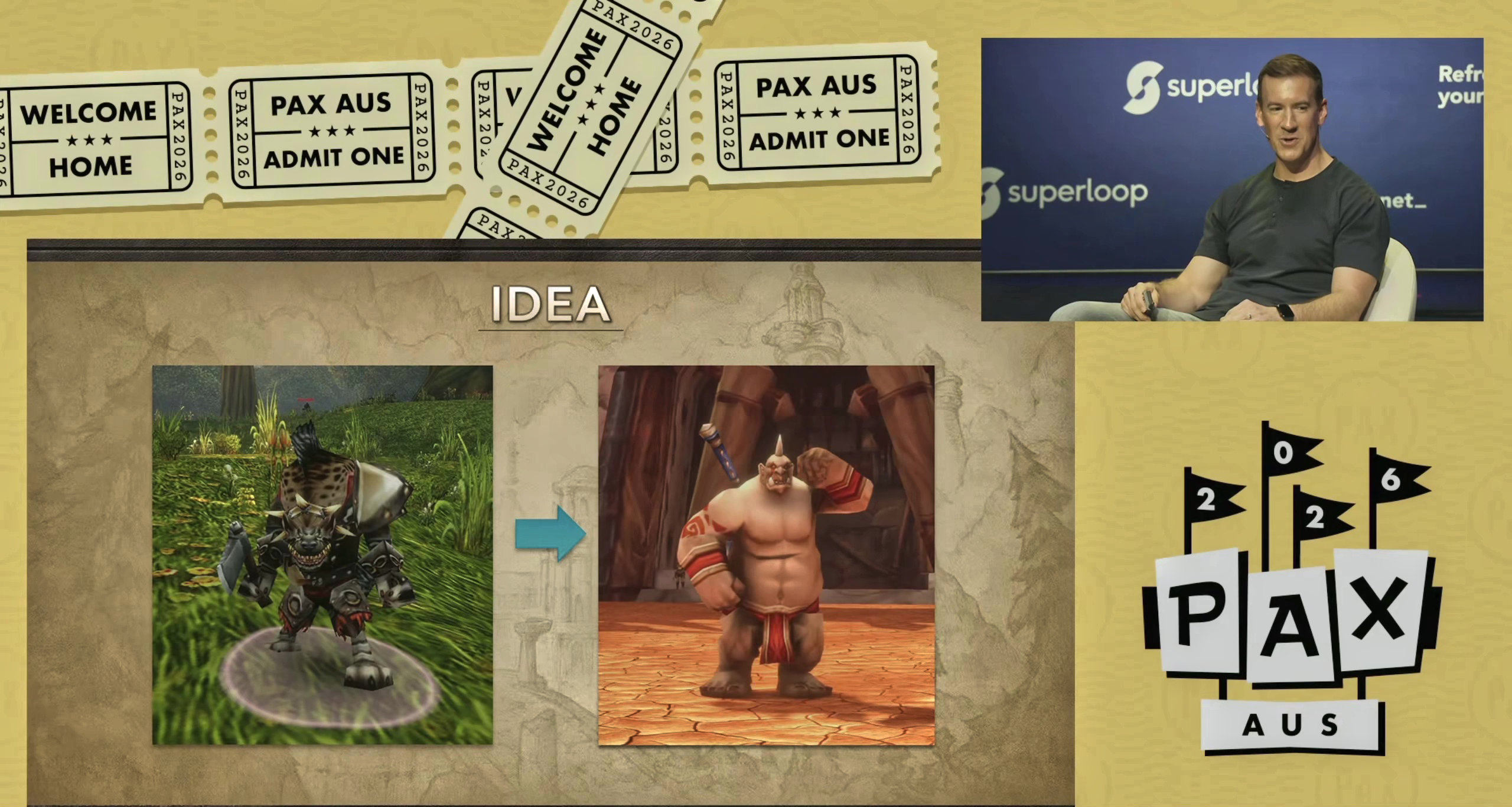
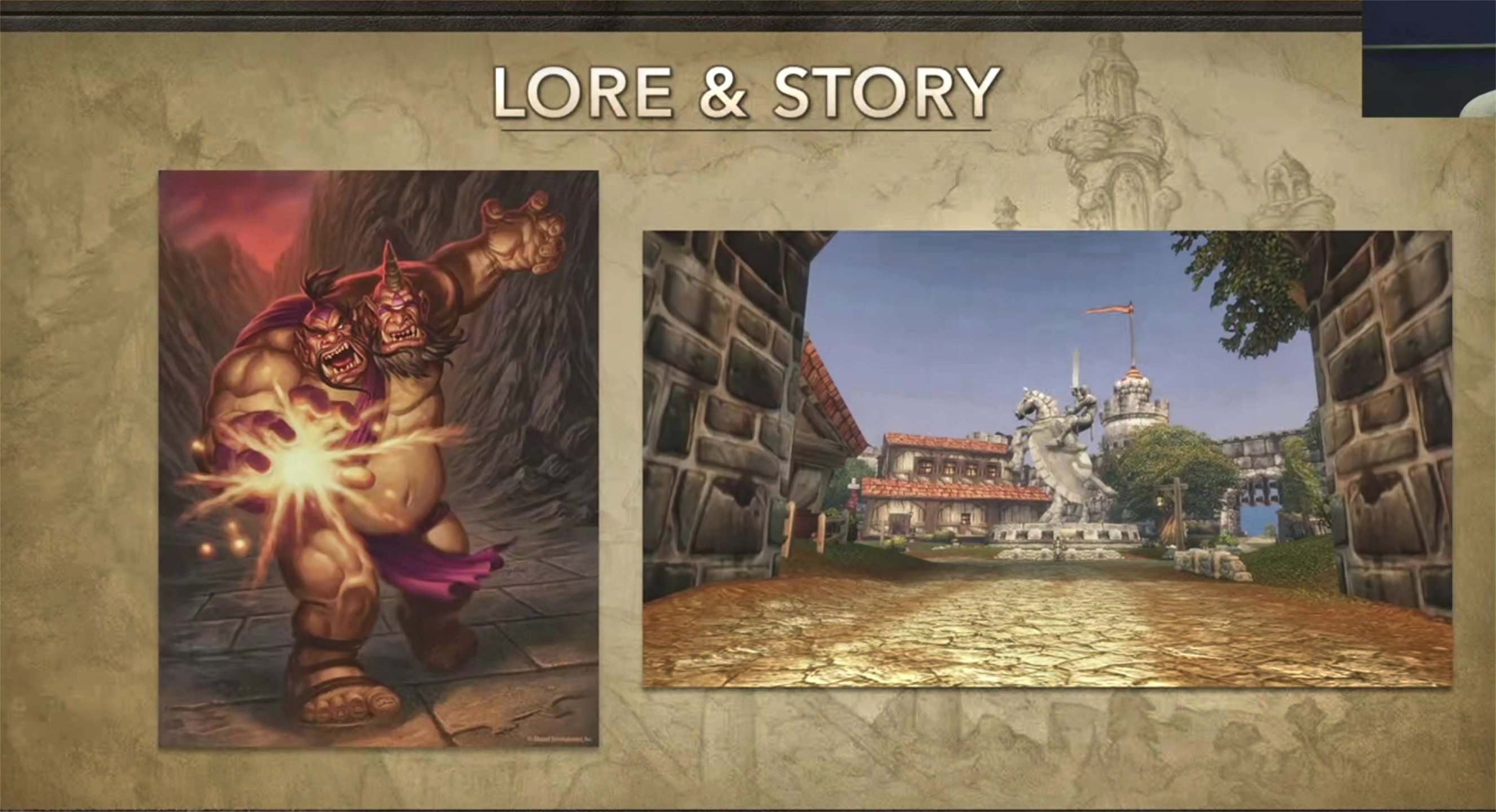
So then we said, okay, we are committing to doing an Ogre dungeon. And then we said, okay, we need lore; we need a story to back it up; we’ve got to make sure it fits in seamlessly. So, of course, one of the most famous ogres is this ogre named Cho’gall, the two-headed ogre that you see on the left up there. Cho’gall, of course, being an extremely closely tied to the Twilight’s Hammer and the Twilight’s Hammer involvement in the original wars that were showcased in the original Warcraft RTS games.
We said, okay, that’s perfect. Let’s do a Twilight’s Hammer-themed Ogre dungeon. And then it ended up fitting in seamlessly with the rest of the zone. There’s a faction located in there called the Brotherhood of the Horse from the Alliance, and I’m kind of going down a lore rabbit hole here.
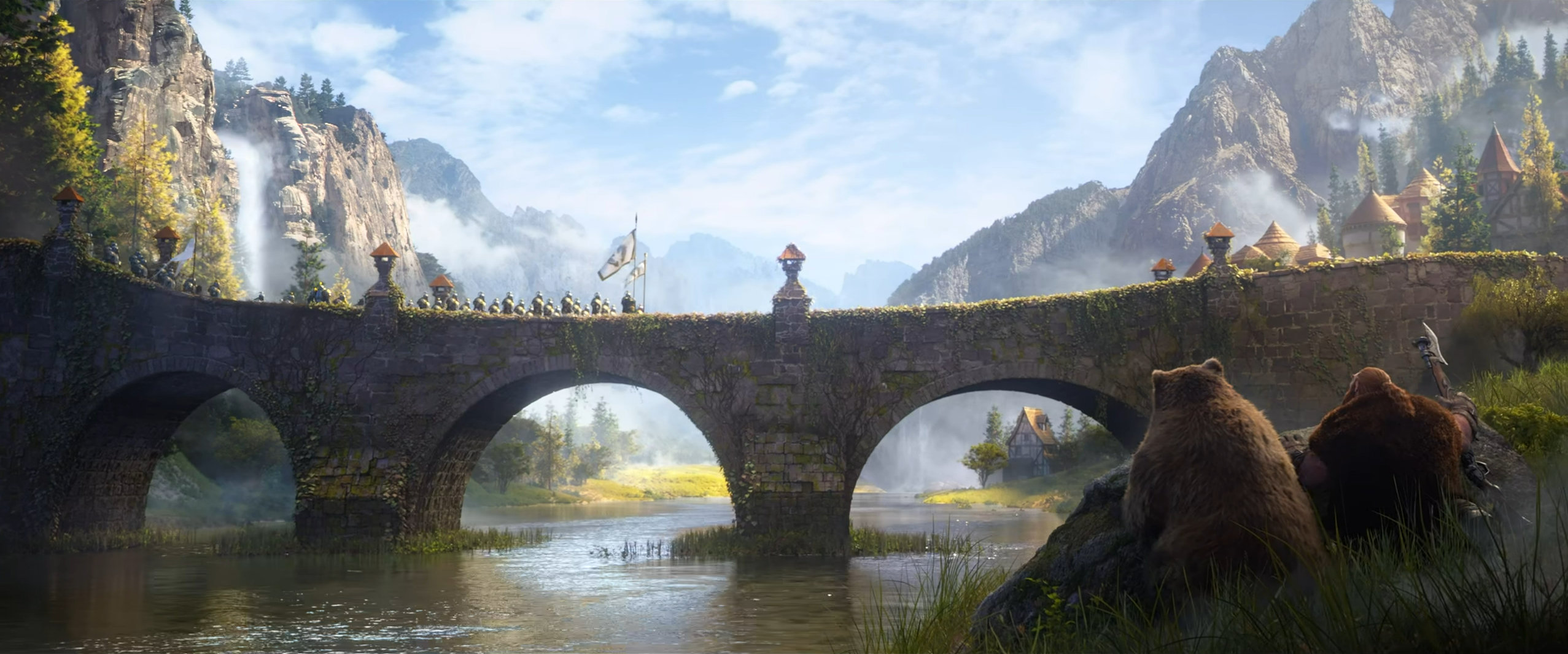
They’re from the original Warcraft RTS game as well, which fits in seamlessly. And if you’ve read the manual of the original Warcraft RTS game, you might learn a lot about them, too. For those who may not have noticed, by the way, when it comes to the Brotherhood of the Horse, in the opening cinematic that you showcased at BlizzCon for World of Warcraft: Forever, if you look very closely, you can actually notice their insignias on the army that’s marching over the bridge while the dwarf and bear are hiding. So take another look at that if you haven’t seen it. It’s been in there this whole time, these past few weeks.
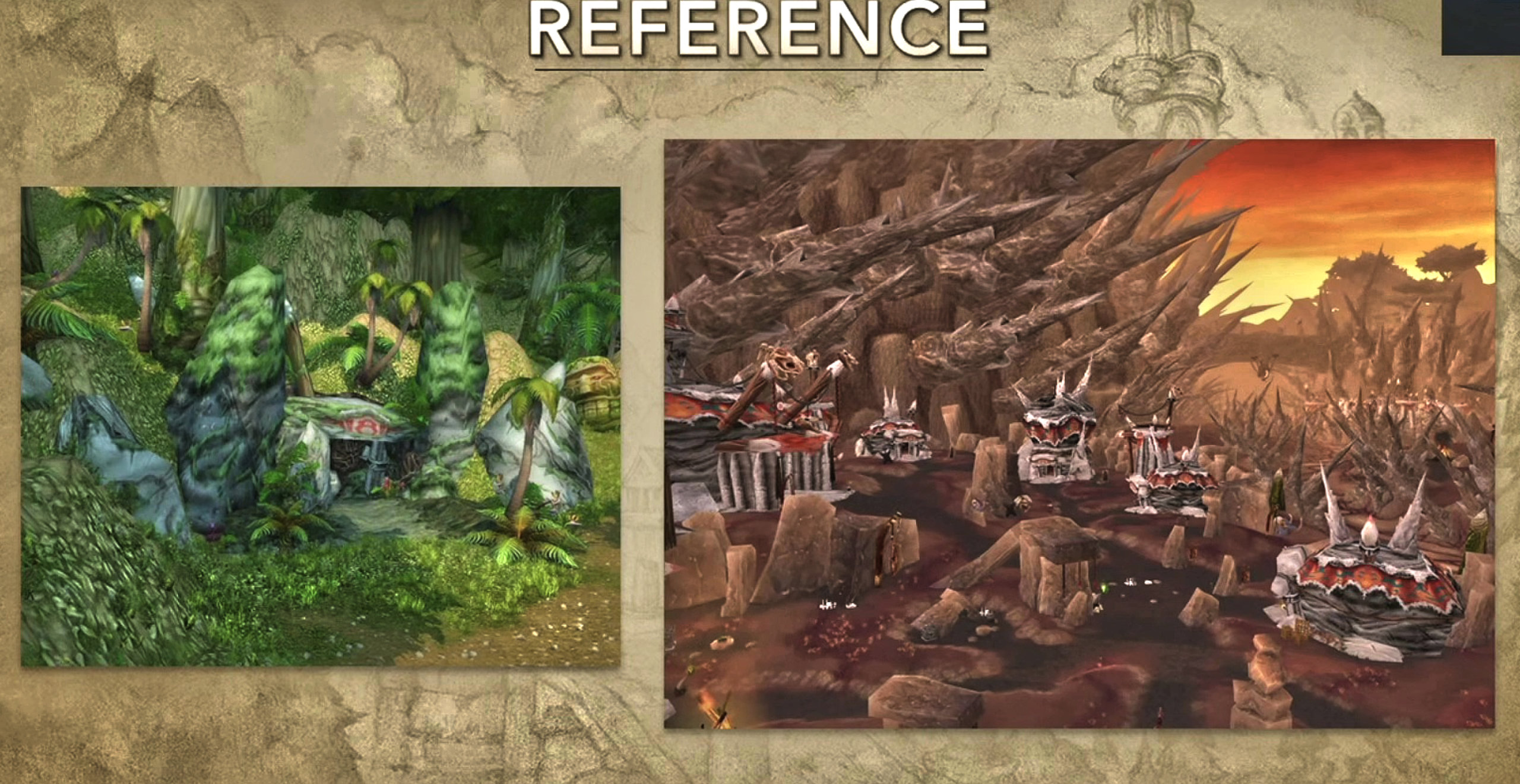
That’s the lore in the story. Then we say, okay, this is great. We wanna do an ogre dungeon. Perfect, this is awesome. What assets do we have to reference for what this thing’s gonna look like? In the original vanilla era, there’s not a lot of ogre structures. In fact, really the only thing that we had to look at was ogre mounds.
I believe in our creativity. I don’t know that we can make an amazing dungeon built out of ogre mounds. Although I’m sure we could figure out how to do it if we needed to. But luckily for us, just looking just a little bit beyond that, but still feeling like it fits in that classic space, was Blade’s Edge in TBC (The Burning Crusade) and that whole zone and that whole area. Lots of ogres in that area, so a lot more reference for us to be able to draw from when it came to their structures. So that’s wonderful.
Then we moved on to really our request list. This is an actual image from our JIRA. For those who don’t know what JIRA is, it is a project management software. This is the most interesting part of the presentation, I promise.
Holly Longdale: (laughs) Sorry, I love JIRA. It’s great.
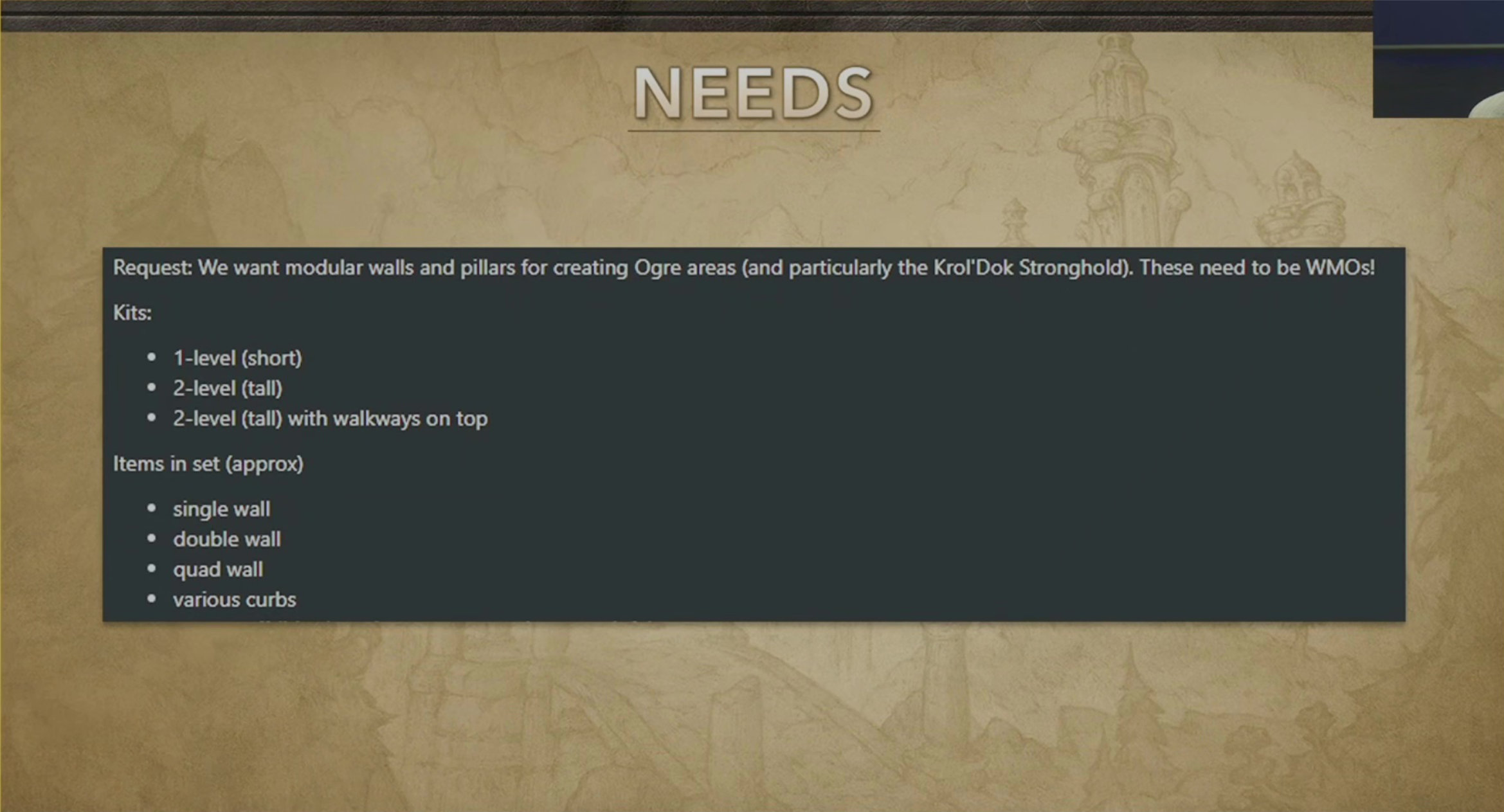
Clay Stone: We all do, we all do. But this is a screenshot of one of our request lists from within our JIRA that basically talk through what are the assets that we’re gonna need to actually build this thing. This is an important point, because this is when development really starts parallelizing, and you have each of these disciplines working on different things at the exact same time while all staying in sync with each other. Really cool stuff.
Going back to worldbuilding, this is a zoomed-in space of what that space looked like back in the original vanilla era, again from a space-eye-view.
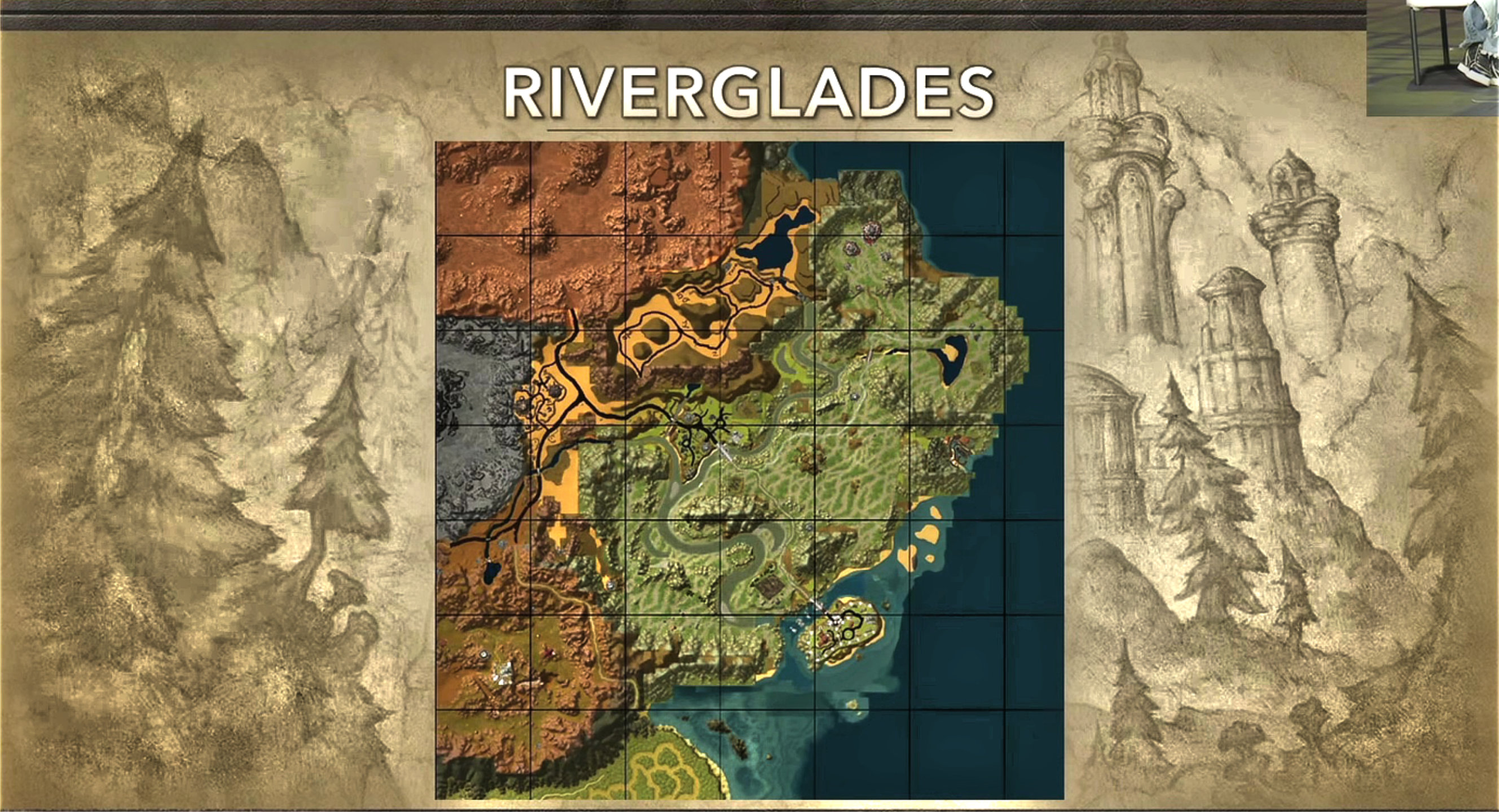
And then this is what that space looks like after our worldbuilders and our world artists really started working on it. You can see the whole space of the dungeon really painted in orange on there. And then I can zoom in a little bit more on it.
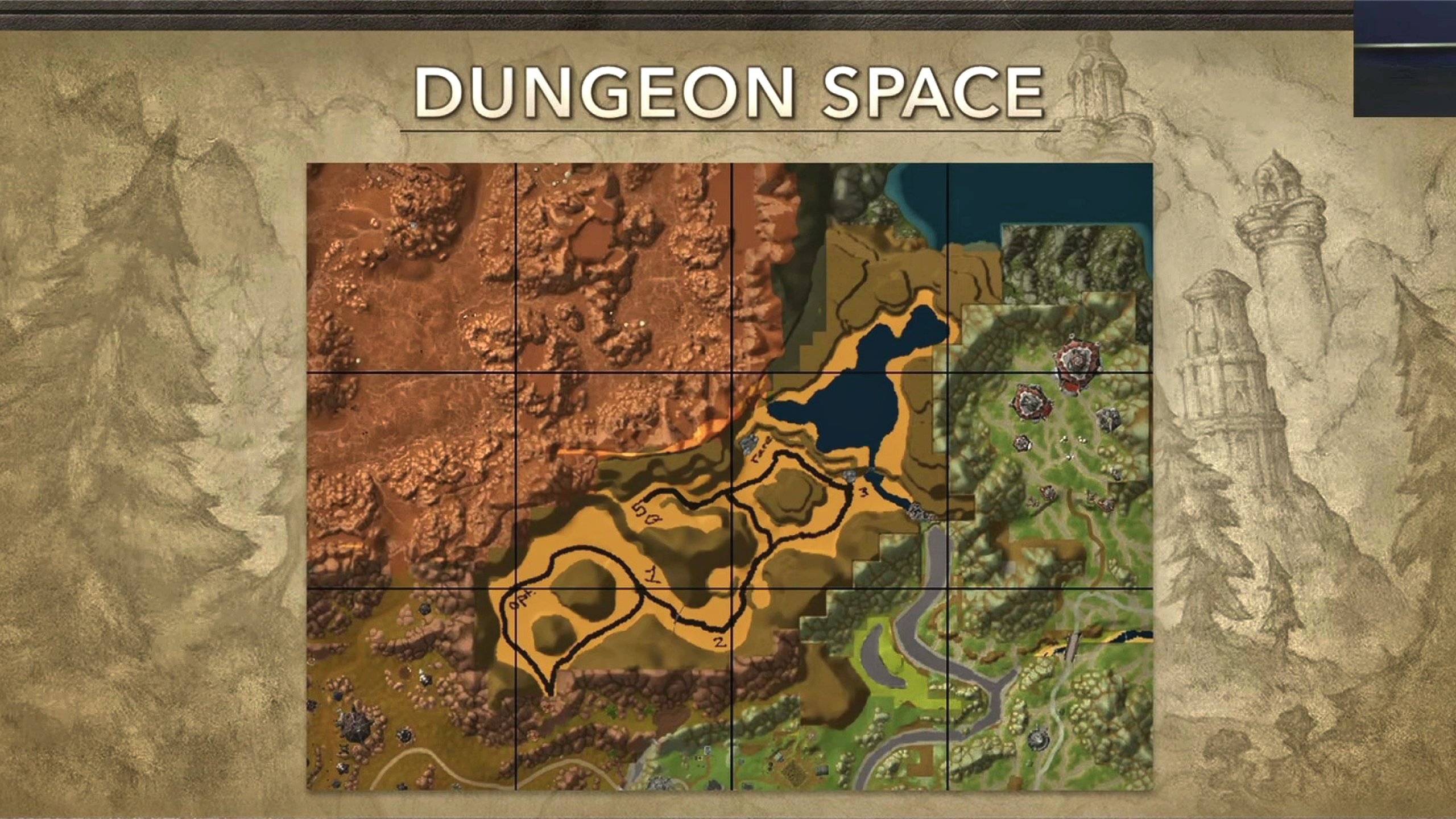
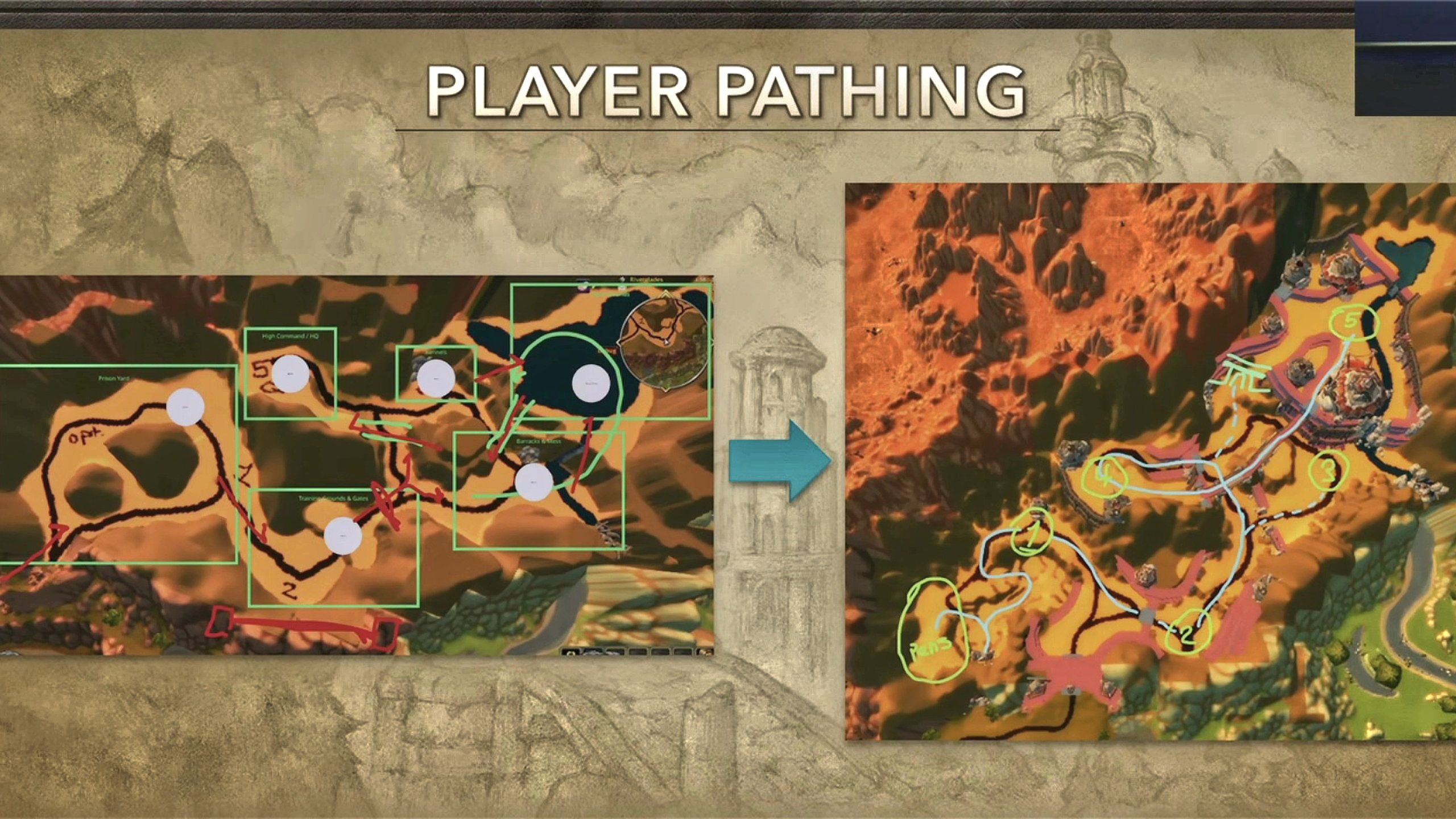
And then we talked about player pathing, and this is something that our encounters team works on a lot. We’re getting back to MS Paint artwork. We’re back at it. So you can see on here, those white circles on there are where we think our dungeon bosses are gonna be represented within the dungeon. And then we also number them. And you can see we draw black lines between them on what we think the player pathing is gonna be for all of this. And then the ordering that they’re likely going to encounter the different bosses.
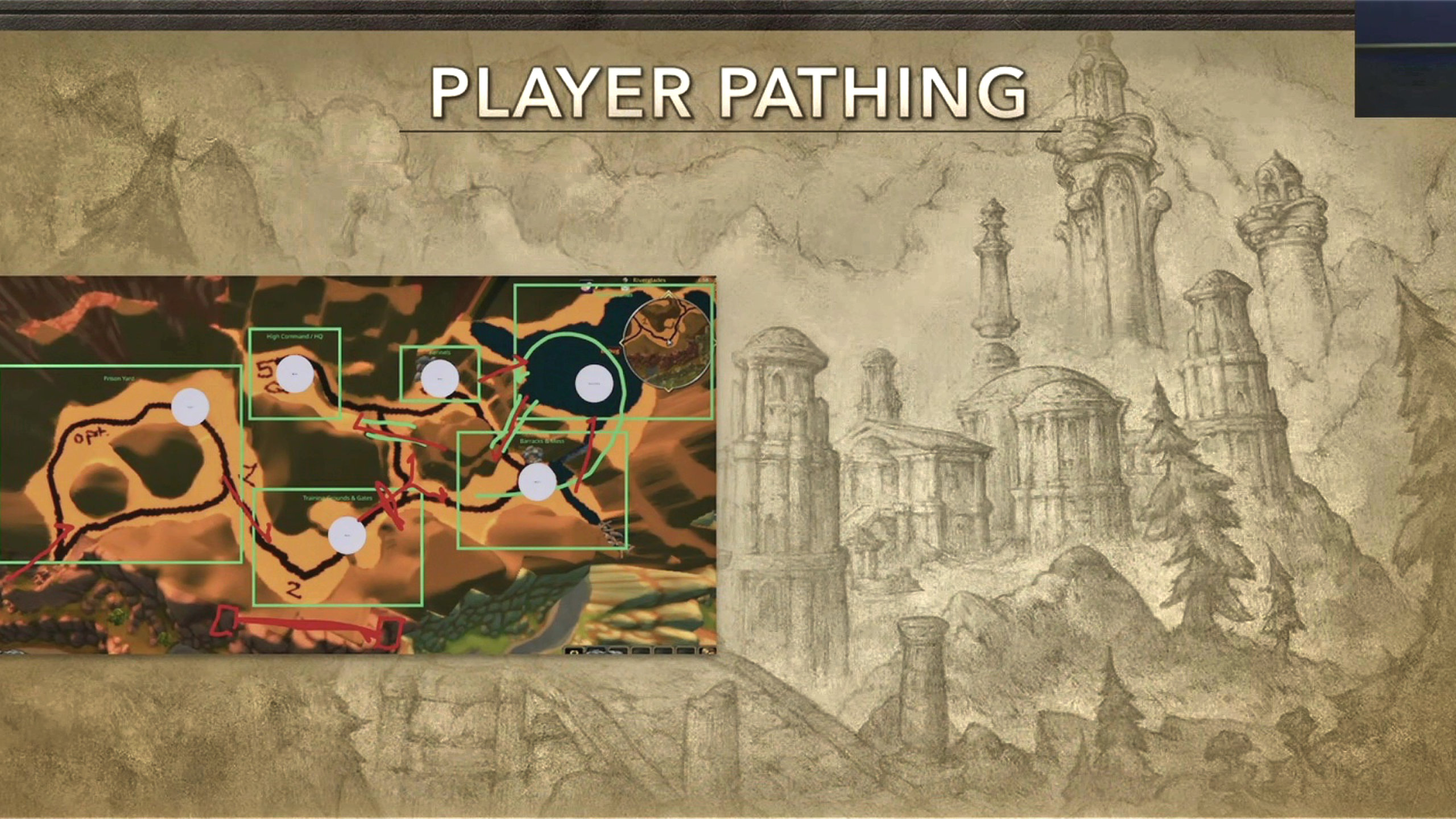
So we do that and we kind of play test it a little bit, and that’s when we realized, going through this, that we were gonna send players all the way up the hill, and then back down the hill. Turns out that’s not very exciting as far as progression is concerned in a dungeon. So we switched it up, and we said, okay, no, we are gonna go up the hill and end the dungeon at a really cool high point up there. So it’s one of those things that we figured out again through greater discussion and playtesting and things like that.
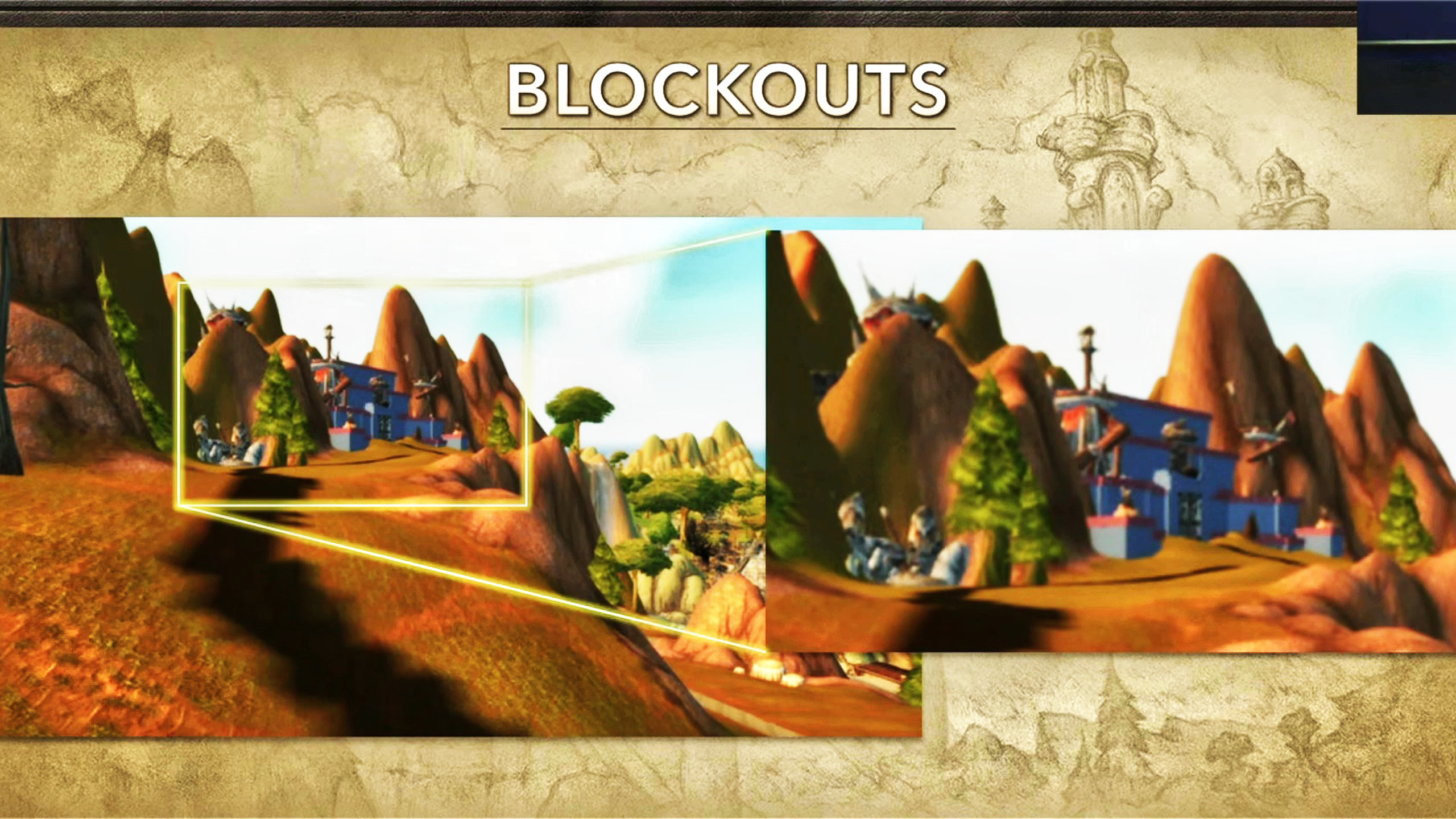
And then we get to the Blockout Phase. The Blockout Phase for our worldbuilders is when they really take simple geometric objects and put them into the game world to get a sense of size and scale, and also a little bit of an opportunity for players or our team to be able to use characters to run around the world. If I enhance this, you’ll see it is a very imposing-looking fortress up on this hill, which is really just a structure made out of geometric objects.
And then more blockouts from there. You can see what it looks like inside. I should note on this, though: I’m sure most folks thought that from the space-eye view that we had just used MS Paint art to paint orange. No, we actually painted the ground orange and painted those black lines on the ground when we’re actually developing it.
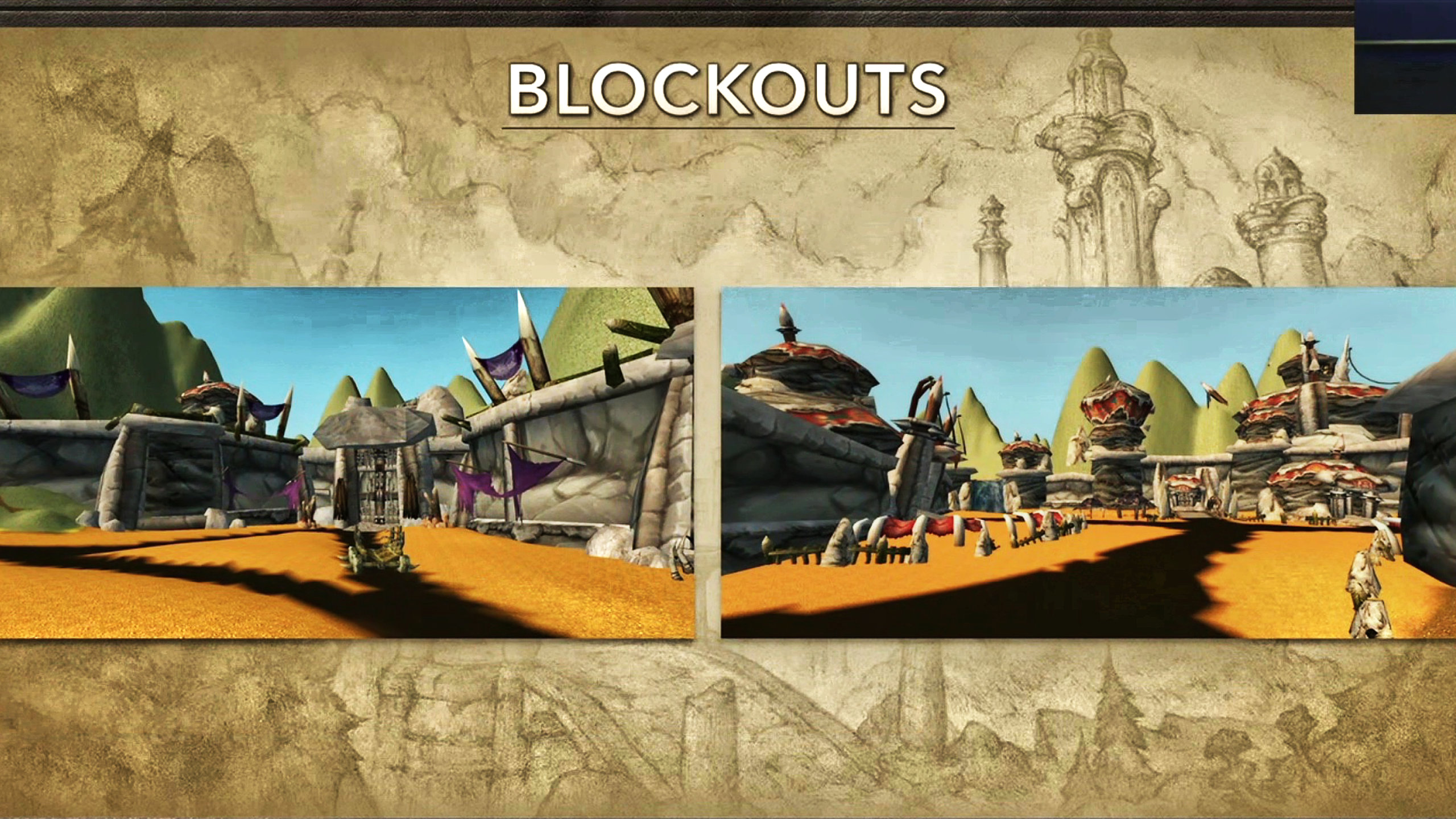
Holly Longdale: I do love, though, like for our team, when we do blockouts, normally it’s just in grayscale, like just literally putting — Our team cannot do that. Well, just put some trees, and it’ll be pretty. And I love that about them because they sell us a little bit on the vision. We can’t just do gameplay. We have to be in there.
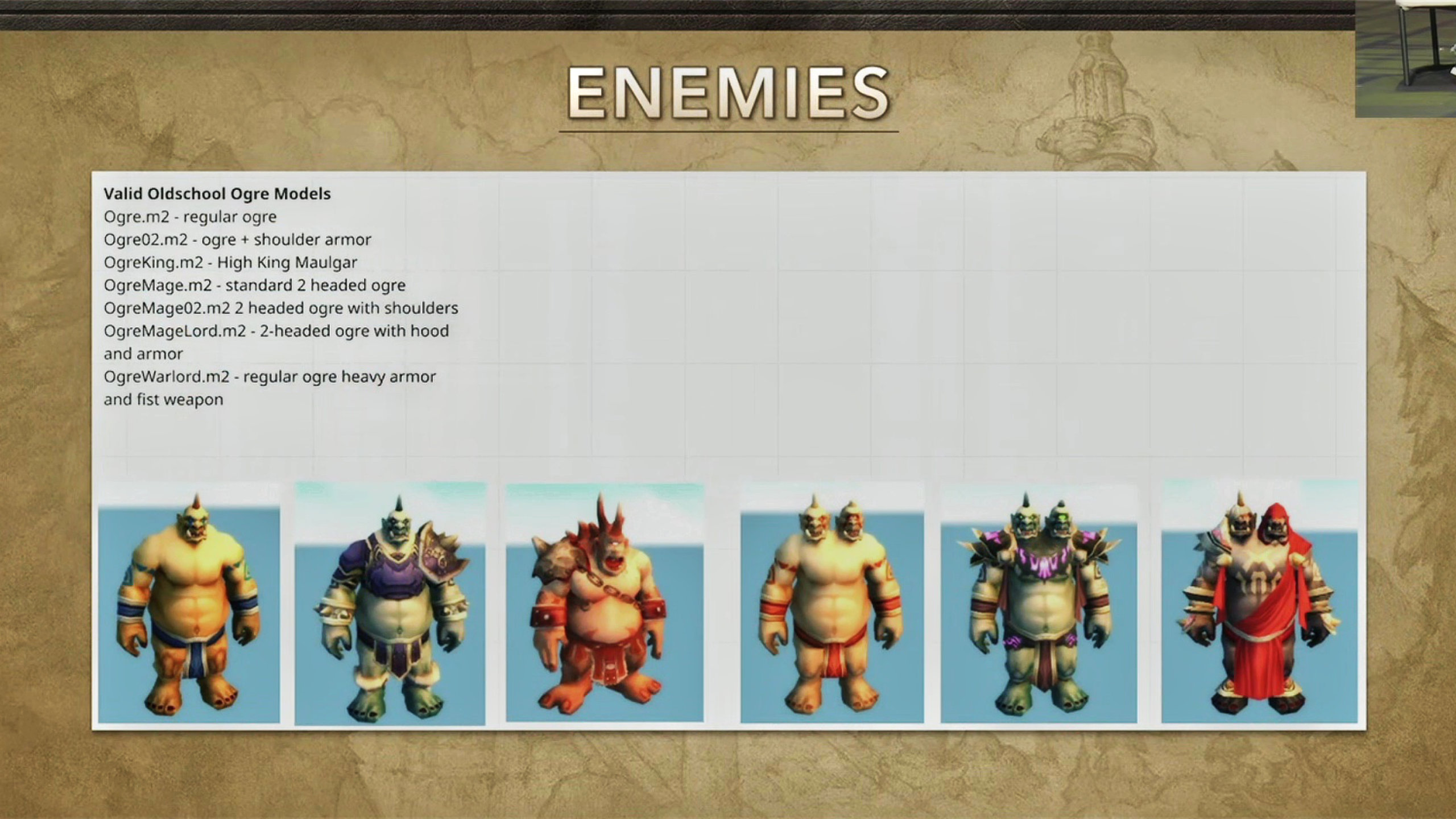
Clay Stone: So then we talk about enemies. And for this part, we really look through this incredible catalog of everything that we’ve built in World of Warcraft history to look at enemies that either already exist, or we can create new versions of that we can bring into this dungeon. An important point about this: if you look in the top left, it uses the world Valid Old School Ogre Models.
Critically important to us. I am gonna double down on the world valid to make sure that any of the assets we may be pulling from or recreating for this game feel like they fit into the world. And that’s been a process over the course of development to make sure that everything feels seamless and we’re only working with the assets that make sense for it, too. So we have to be very strict about that.